Today is the winter solstice, aka the darkest day of the year. There are fewer minutes of daylight today than on any other day.
It’s my favorite day, not because I don’t like light but because I do. I love light, and if today is the shortest day, then we start getting longer days tomorrow. It’s like hitting rock bottom but knowing you will have the strength to climb back up.
That’s why I wrote my book Winter Solstice, which is now in print in my “Author’s Edition”. This is a day we don’t always appreciate or even note, but it’s worth remembering if there’s a down, there’s usually an up that follows.
I often get questions about getting published. My answer?
I have no clue. I’m definitely not an expert.
But you’ve been published. Look at all those books. And you publish a literary magazine.
And I do. And I admit I’m a little surprised when I look at my backlist. Because, yes. I have a lot of published books. And I’ve learned a lot about how to publish them. I know how to format a manuscript, how to upload it to Amazon and Smashwords, I’m usually able to edit my own stuff, and I’m slowly learning the ins and outs of designing my own cover and illustrating my books when necessary.
I try, very hard, to explain that my path to being published isn’t really going to work for everyone. I’m self-taught, but I know my limits and I know when I need to consult an expert. I’ve hired developmental editors, for example, because I know that’s not my field of expertise. I often hire someone to design covers for me, or at least I used to, back when I wrote novels. If I ever write another one, chances are I’ll hire someone for that, too.
With all that said, I have one bit of advice for new writers who want to self-publish. Don’t go to a self-publishing publisher. Do as much as you can yourself. And take an a la carte approach to the rest. Chances are very good if you go to a publisher who charges you to publish your book, you’ll be overcharged and your book will not be a quality product. You’ll make less on royalties from your book because the publisher will take a cut, and you’ll be overcharged for author copies of your book, making it difficult to sell them yourself and make a profit. (I know books are overpriced, but nobody really wants to pay $20-plus for a paperback book.)
And so…I’ve finally broken down and put all my knowledge into a short (about four and a half minutes) presentation. I may eventually start giving this presentation in person, but I’m not a great public speaker except when it comes to reading my poetry (and so far nobody’s wanted to pay to hear that). Plus, as I said, I don’t really consider myself an expert.
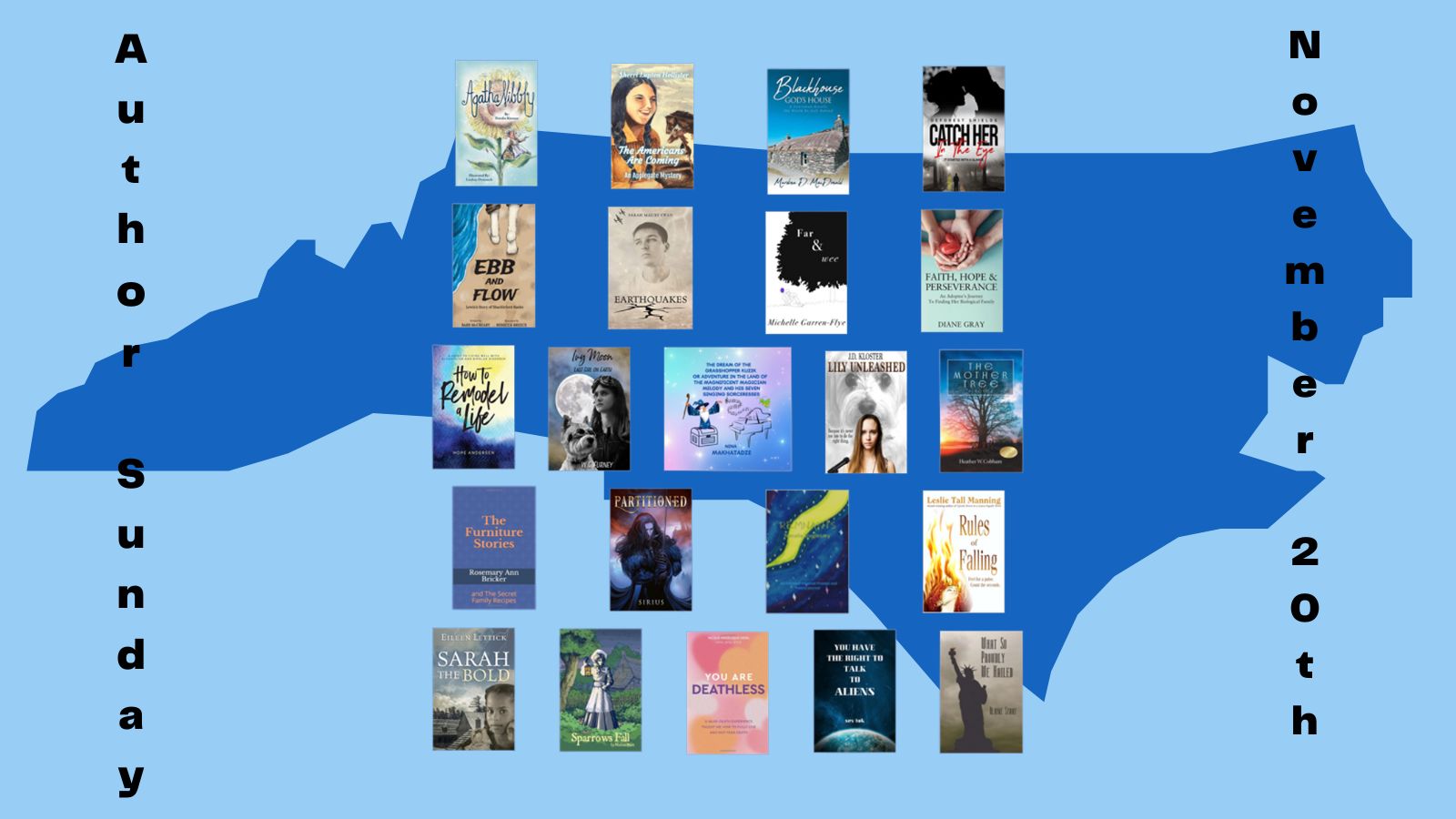
This Sunday, November 20, I get to do something I don’t often get to do anymore. I’ll be just an author selling her books.
I’m not totally certain I remember how to do that…
Running a bookstore was a dream of mine for a long time. I used to haunt the two little bookstores in my hometown. The Book Nook was my favorite because it was used books that I could actually afford. (I did buy my first new hardback book there, though. Black Beauty and Other Horse Stories. It cost $15 and I still own it.) Highland Books was where I went to dream. I didn’t have enough money usually to buy the books, but the owners were tolerant and didn’t say anything if I curled up in a corner with a brand new science fiction novel they knew I couldn’t buy. I wonder how many people bought books there that I had already read?
But I digress. I dreamed of owning my own bookstore for a long time but I didn’t realize that when I got one, I couldn’t just be an author anymore. Yes, I write in my bookstore. And sometimes I sell one of my own books. I’m on the bestseller table here, so I do sell some here and there, and it’s definitely exciting when I do. But I’m mostly here to sell other people’s books.
On Sunday, however, I will be at the New Bern Farmer’s Market from 1-4 p.m. with a slew of other authors, all selling our own books! I’m planning to take all the books I have here at the store (well, maybe leave one copy of each on the shelf) and hope to sell them and maybe get some people reading my poetry.
And still I won’t be able to resist asking what kind of book people like to read. And I know enough of the other authors there so I’ll know if their books are a better fit than mine. And I won’t hesitate to send them that way…so it might not be that different from being in my little bookstore at all. 🙂
It’s one thing to tell you how special this little book is. It’s another to show you. So here I am in a one-take video, reading my book out loud and explaining it as well as showing you the pictures as best I could.
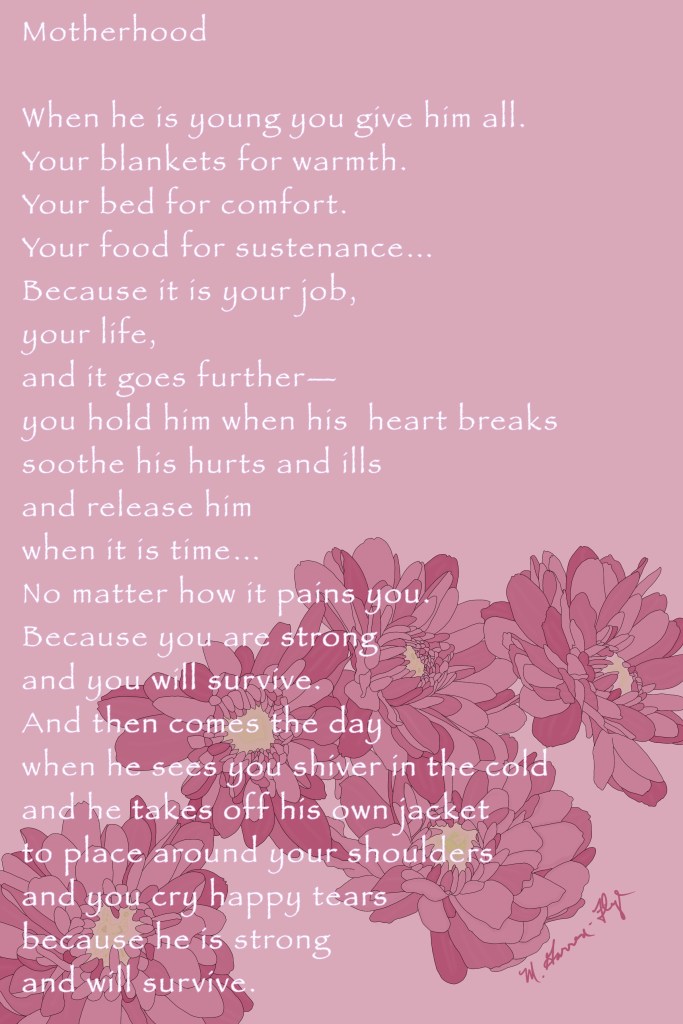
This isn’t exactly a new poem. It was inspired by my oldest son but over the course of the past year I’ve seen more and more instances of strength in all three of my kids. They’ve been generous with that strength, too, loaning it to me when I needed it. Like a warm coat they take off their own shoulders to place over mine.
So thank you, kiddoes. Without you I wouldn’t be me.
Poem and illustration copyright 2022 Michelle Garren-Flye
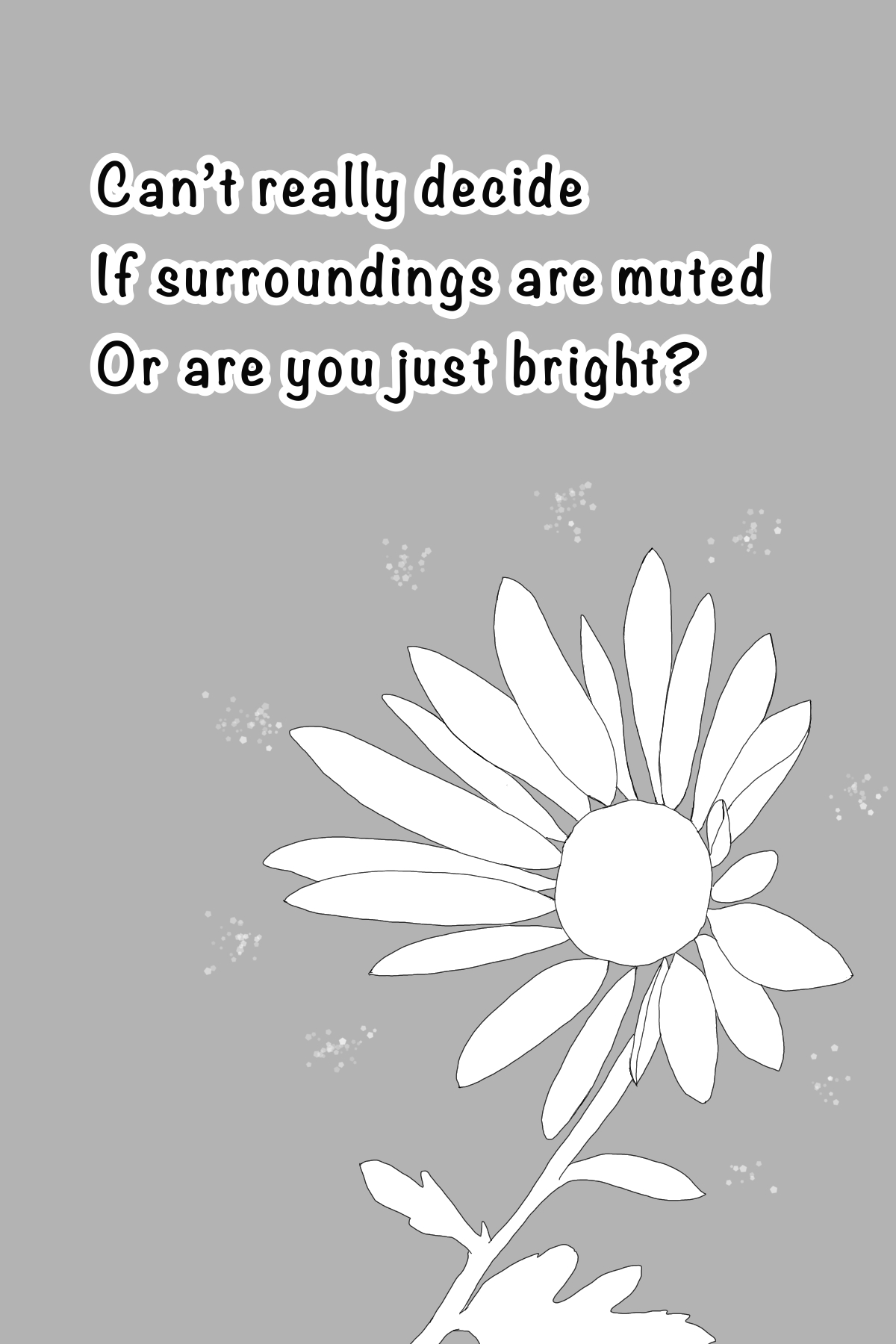
Today is my birthday, and I’m celebrating by writing, but not just writing. I’m writing whatever I want. I’m also going back and reading some of what I’ve written in the past. If that sounds like self-gratification, keep in mind that I write what I want to read. It’s the main reason I enjoy it so much.
But I wanted to share another little bit from UnSong. I’m still working hard on the illustrations, and I’ve done most of the easy ones (and by that, I mean the ones that lend themselves to illustration more easily—they have a definite image. Poetry being poetry, not all of the poems in my volume do…or the image they have is a bit difficult for a novice artist like me to put on the page.
My point is, I’m getting there. The book is taking definite shape now. And I’m using Scrivener to build it, so I’m kind of proud of that, too.
I guess old dogs can learn new tricks.
Illustration and poem by Michelle Garren Flye copyright 2021
This weekend a friend tagged me in a post on Facebook. It was an article by Adam Stern in The Chicago Tribune entitled “Independent Bookstores are More Than Stores”.
This article gave me a lot of feels.
First, as a reader, I totally agree with him. I remember as a kid haunting local bookstores. I would sometimes spend hours browsing bookstore shelves. That’s how I discovered Anne McCaffrey, Piers Anthony and even Jane Austen. We had a used bookstore in our town called The Book Nook. I would often trade books in there. I’d bring in a stack of dog-eared novels and leave with another. I believe that’s where I first made the acquaintance of Stephen King. There is absolutely nothing like browsing a bookstore’s shelves and taking home a new book by a new author you might never have tried before.
And yes, this experience is slowly dying off.
Second, as an author, I have a love/hate relationship with Amazon. They make it easy for me to publish my books. It costs me nothing but time to put my book up for sale on Amazon. BUT they make it easy for anyone to publish their books. Forgive me for sounding a little uppity here, but when I decide to publish something, it’s gone through intensive editing. I self-edit, but I am an editor, so I can do it. My books are not the stream-of-consciousness, unedited, full-of-typos books that have given independent/self-publishing a bad name. In fact, I would venture to say that my books are better edited than some bestsellers. But it’s difficult for readers to trust self-published books because anyone can self-publish. Hence, the love/hate relationship.
I cannot hate on Amazon when they provide essential tools for me, though.
Third, as a bookstore owner. Okay, I should hate Amazon, right? Again, there’s mixed feelings here. My store serves a different purpose than Amazon. You will not find the latest Oprah pick (does she still do that?), the newest best seller, the trendiest hot read on my shelves. I have well-loved classics, dog-eared novels, a decent selection of nonfiction, and LOCAL, INDEPENDENTLY-PUBLISHED AUTHORS. So as far as that goes, I don’t have a problem with Amazon. When someone comes in and asks for Nicholas Sparks’s latest or the new book by Barack Obama, I cheerfully refer them to Books-A-Million or Amazon. “But I want to keep my money local and help you,” they say. “So browse the shelves and find something you like from what I have,” I reply.
That’s my problem (and, I guess, Stern’s) with Amazon. But it’s not just Amazon. It’s big publishing in general. And people like Oprah who presume to know what other people should read. They have the influence and resources to push the same authors over and over again. The same ideas get consumed over and over. Just because I can publish my well-edited, pretty damn readable book doesn’t mean it’s going to be discovered by readers who have been conditioned to want to read the latest bestseller, the latest trendy nonfiction, the latest thing Oprah said was good.
So, to those who call me up and ask for the book they heard about on Good Morning America this morning, I say, “If you truly want to help your community and keep your money local, have a look at our local author section. There’s some good stuff in there that you will never know about if you don’t give it a try.”
Oprah Winfrey is quoted as saying, “Reading is a way for me to expand my mind, open my eyes and fill up my heart.” That is indeed what reading is for many today. But it’s also a privilege and a right that human beings of all races had to fight for.
Before the invention of the printing press, only the upper classes had books to read. They were just too expensive for the common folk. Too busy surviving plague and poverty, many of these people never learned to read. Bibles, especially, were kept to the clergy and the church, mainly because they were the only ones who could read it in its original Latin. God forbid that the lower classes read it for themselves and start thinking and interpreting religion for themselves.
But then came the English translation of the Bible—which was banned for that very reason. It was smuggled into English hands by determined bibliophiles, but William Tyndale, the translator who lived in exile in Europe in order to complete his life’s work, was executed.
Of course slaves were not allowed to learn to read. Not only were there no schools for them, it was against the law to teach them in most slave states. But learning finds a way. Some slave owners allowed their slaves to learn to read as part of Christian education, and some educators found interesting ways around the laws, including a floating school on the Mississippi River.
My point here is that all cultures and races have fought at some point for the right to read and write, and in an era such as the one Americans are going through right now, we need to preserve every last bit of that right. Our president threatens social media and the press, bookstores in Minnesota are battered by protestors and looters, and all of this is happening against a backdrop where independent bookstores and small presses are struggling for survival anyway.
So my plea is this: Don’t be part of the forces that would oppress you and take the light of knowledge away. Don’t burn the bookstore your ancestors fought for.
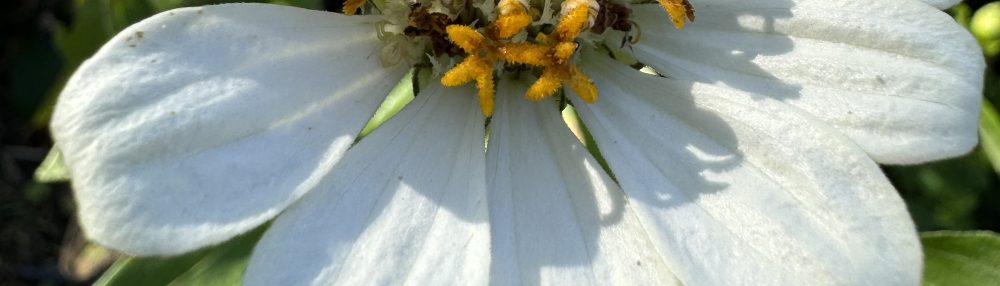
Photo by Michelle Garren Flye
Today’s anti-information, non-factual age is a dangerous one for local bookstores, the media and science. In the end, it is up to us to make certain our heritage and ways of life are preserved. Protect what generations of every culture have fought for. Keep our bookstores open.




 BREATHE: Michelle Garren-Flye