Poem: Out of Season

I’m exploring a connection between haiku and sonnets again. I did it once before with a haiku by Matsuo Basho. I like the way that one turned out, and as I’m either at an impasse with my novel or at least a long hesitation, I thought I’d try to break out of it by writing a haiku and turning it into a sonnet.

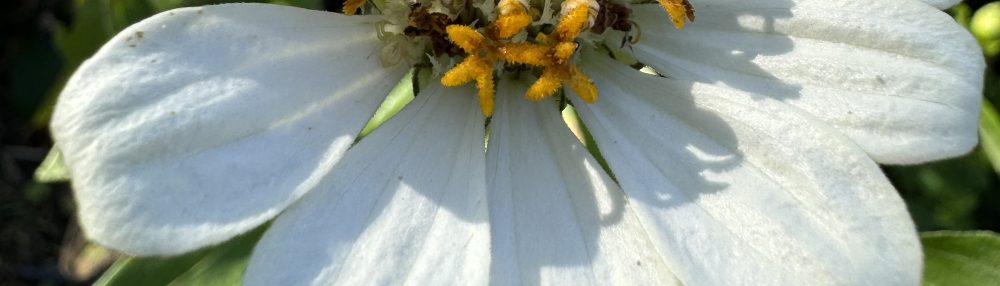
It’s not the most cheerful of poems. In fact, as I wrote the sonnet, I began thinking about how we all try to hang onto our youth and how that can appear. I used to think I’d prefer to age gracefully, now I’m working out daily, trying things I’ve never tried before, dying my hair pink…it all feels right, but maybe it’s not?

Then again, if you never had a chance to bloom in spring, maybe you take the opportunity when you find it.

fall shadows don’t flatter
your rosy vernal blossoms
it’s too late for you


Out of Season
By Michelle Garren-Flye

What are you doing here, little pink bloom?
It’s obvious to all your time is long past
and putting off death just creates gloom.
Your beauty offends, you weren’t meant to last.

You weren’t meant for this kind of shadow
when even the sunlight is just a tad too gold
casting bare limbs in an unearthly glow
as a wind shivers by, leaving you cold.

I’ll have to bury you in the dry, brown leaves.
Remember how they looked in your youth?
That’s when your beauty was sure to please!
Now I’m afraid, it seems uncouth.

Stay buried please, accept what’s been done;
for flurries and frigid winds, the time has come.
Photo and poem copyright 2024 Michelle Garren-Flye

A fun exercise with a poem: For Basho

Today I did something kind of fun. I have a book of Matsuo Basho’s haiku on my desk that I often read when I’m experiencing writer’s block. It’s a beautiful book even though now it’s a bit beat up and coffee-stained. But the pages are full of haiku by the master of haiku. Sometimes when I read them, I feel like I can picture him on his travels, taking inspiration from the simplest of things, writing his verses even in discomfort, possibly hungry, cold, stuck in bad weather, probably tired.

And then I wonder how on earth I can claim any adversity at all.

At any rate, today I was reading some Matsuo Basho and I found this one:

snow on snow

this night in December

a full moon

—Matsuo Basho

I’m currently editing my book Winter Solstice for republishing so this little haiku caught my attention, especially when I read the backstory of it. Basho wrote it for two fellow poets who were arguing, hoping by pointing out the beauty of the moon’s glow on the snow, he could defuse the fight.

I don’t know if it worked for them, but it gave me something to think about. I wondered what it would be like to write a sonnet with the same idea. So I did.

For Basho
By Michelle Garren-Flye

Why persist in impatience and strife?
When yonder field full of starflowers
reflects the moon’s light into our life,
how can this world of war be ours?

Sit here beside me, give me your cares.
Worries, bad habits, and visions begone!
Along with all the stuff of your nightmares—
the ones that sometimes linger on.

This world is full of beauty, you know:
meadows turned into a galaxy of stars
by nothing more than the moon’s glow
concealing all of our cuts and scars

Take heart! Come with me and dance
in soft grass among stars and planets.

It’s hard to remember sometimes that our world has been through a lot and survived. Sometimes the news makes it seem we are on the brink of all the disasters. Politicians make money off our fears, the media churns out new ones every day. But today I saw a Monarch on a bunch of pink lemonade lantana, and it made me happy.

Photo and poem copyright 2024 Michelle Garren-Flye

National Poetry Month: Fortune Cookie Poetry 10, “Laughter shall fuel your spirit’s engine”

As soon as I read today’s fortune, I remembered one particular night. You see, I love to laugh, but sometimes I think I’ve forgotten how. Then I have a moment when laughter lights up my heart again. I know this fortune is true, but I don’t always know how to make it true for myself.

Maybe that’s how we all are, to a certain extent. Surviving day to day.

I can say that nine times out of ten, when I find myself in that warm light of laughter, it’s with my kids, the human beings I love most in this world. And that’s what this poem is about.

I chose to write it in haibun format, which was invented by Matsuo Basho, the master of the haiku. A haibun is a prose poem and a haiku smashed together. I’ve attempted them before. I think this one works, to a certain extent.

I hope you enjoy it, anyway!

Photo and poem copyright 2024 Michelle Garren-Flye
laughter shall fuel your spirit’s engine
By Michelle Garren-Flye

They dragged you out, these children who have grown into friends. You’re usually bathed and in bed by now. Tomorrows are always full. You have to be ready. But they want to have fun. They want you to have fun, but fun is not something you practice. There are too many tomorrows ahead, too many yesterdays behind.

The golf place is full, but you have a reservation. They serve beer, so you have some, hoppy smells tickling your nose hairs. The lights are bright, and there is a heater nearby so even though you’re outside in January and there will be snow tomorrow, you take off your coat. Frustration mounts with every golf swing, until your oldest son misses the ball entirely and yells, “Fun!”

And there it is, bubbling around you, the energy needed to fuel your spirit, as first you and then your children who are now adults and friends—your yesterdays and your tomorrows—shout it together, hurl it into the night air with the white golf balls hailing onto the astroturf:

giggling bubbles
burble in your life spirit
laughter is your peace

Silence (a poem)

Poetry continues to be my main objective in spite of a couple of ideas I’ve had about novels. If I hear about a new form of poetry, I have to try it out. And then I have to stretch it. Remember Stretch Armstrong? How you would stretch and stretch him to see how far you could stretch him and he’d still go back to his original form…until he didn’t.

I sort of feel like I did that with haibun. Haibun is the combination of a haiku and a prose poem. Matsuo Basho wrote them. I discovered them relatively recently and decided to give them a try. And stretched the form a bit. What do you think? Is it still a haibun at its heart?

Silence
By Michelle Garren-Flye

it’s awkward, silence,
because it wants treasuring
and I reject it

laying too heavy on my ears in the dark, begging to be broken, shattered against the brick wall, revealing the death of sound ringing in my ears, spilling out like the yolk of an egg until the utter madness is stunned by a brief click in the wall behind the thermostat as the furnace breathes life into our emptiness…

don’t rejoice too soon
complete silence verges on
total perfection

you will seek it again, want to crawl into it, feel it envelop you in velvety warmth as if it can never break because it always always bends and that’s why you can never make friends with silence, why you can’t love it even if you want it, you will always seek release from it, but…

the birds will ghost you
the wind and waves will give up
leaving you…awkward
November flower. Photo by Michelle Garren-Flye

Just make a left

Do you ever just wish you could stop following all the rules?

I know I do. I see other people doing it. In the carpool lane when it’s obvious there’s a faster way than the long line of cars leading to the proper exit. Just make a left instead of a right. You’ll get out a lot faster.

Forget the rules.

Who’s gonna care?

Ah, but I’m a rule follower. It’s about honesty in my opinion. There are no shortcuts. No legal ones, anyway. No honest ones.

It’s like that in my writing as well. If I’m writing a haiku, it’s going to have the proper number of syllables in each line. I know even haiku master Matsuo Basho said if it’s better with the wrong number of syllables, it’s better to write it that way, but I’d rather write and rewrite and rethink and restructure until I’m happy with it. Because I have to follow the rules.

I was considering entering a poetry contest with some of my villanelles. (I’m that pleased with how they’re coming out.) This contest had a section for traditional rhyming poetry, something few editors have an appreciation for. I was encouraged, so I looked up some of their past winners. One of them was a “villanelle”. I pulled it up and read it.

It broke all the rules.

There were no rhymes where there were supposed to be rhymes.

There were no repeated lines or even words.

It was written in paragraph form.

What’s the fun of that? It’s like writing a short story and calling it a haiku. There’s no challenge. I remember my father saying something that has stuck with me for most of my life, “You can call it whatever you want, it doesn’t make it that.”

Hey judges, it’s not a villanelle if it doesn’t follow the rules.

I’m going to keep plugging along writing my haiku and villanelles and following rules. I have no idea why. I could break the rules and write a paragraph and call it a villanelle. I could write a novel and call it a haiku. I might even win some contests that way. But I won’t.

It’s just that I’m a rule follower.

Villanelle #21

Just make a left instead of right!
It'll get you there much faster,
and your schedule's really tight.

Nobody's gonna care if you take flight
and look for a greener pasture.
Just make a left instead of a right.

I don't mean to make light;
I'm certainly not your master,
and your schedule's really tight

No one can really know your plight.
It can't possibly lead to disaster
if you make a left instead of a right

Rules are not always right.
They're not molded in plaster,
and your schedule's really tight.

Perhaps you'll never feel Karma's bite
graze rear skin of alabaster.
Just make a left instead of a right—
after all, your schedule's really tight.

—Michelle Garren-Flye
Fall is around the corner. Photo by Michelle Garren-Flye

Thirteen Haiku

I’ve been studying haiku and how to write it, what it’s supposed to mean. It’s interesting. Haiku used to seem like an incredibly easy format to me. It doesn’t have to rhyme. It’s just a certain number of syllables and lines. Turns out that’s not really all haiku is.

By reading some original Japanese haiku from Matsuo Basho, I’ve learned that there’s more to haiku than just counting syllables and lines. It’s more about the feeling you are left with at the end of the poem. So haiku isn’t so much about what’s there as what’s left. If that makes any sense.

Anyway, here are thirteen haiku I’ve written over the course of the last few days. I’d love to know if you have a favorite. Do any of them leave you with anything?

#1

The gardener prunes

But new growth won’t be restrained

Bright green emerges

#2

Fireworks entertain

But divisive words excite

Rebellion looms near

#3

Stained glass wings hover

Glory in the hot summer

Swoop fast, stop away

#4

2020 sucks

plague, famine, deluge and war

make a new start now

#5

it’s the halfway point

the race isn’t won yet

can we just restart?

#6

Heartfelt empathy

Pain from any side will hurt

Shut down the spirit

#7

No lightning tonight

Just rain falling in the pines

Sounds lonely alone

#8

Dark voices cry out

I search for them in the sky

Black wings spread, take flight

#9

Crows call murderous

Shrieks splitting the morning light

I listen and smile

#10

Desirous waking

Leads to newspaper reading

This day just the same

#11

Stay home to be safe

Wear a mask, don’t go out there

Life is lived this way

#12

Spiders don’t frighten

But dark doubts creep up on me

Fear takes over life

#13

Disaster movie

Background characters await

Saving grace. The end.

Photo by Michelle Garren Flye