
Nine days to Becoming Magic: What do I know about #metoo?

It’s a fair question. I’m happily married to a wonderful man. I’ve never been sexually assaulted. Not by a significant other, a trusted family member, a stranger, a friend. I know people who have, though. Several.

Think about that for a minute. I know several people (I could name about six) who have been a victim of a violent crime. If I know 600 people (and that’s generous because I’m practically a hermit) and I could name six who have told me what happened to them (and it varies all along the spectrum of sexual assault from date rape to outright attack), then one out of a hundred people I know have suffered from this crime. If you count the number of women who have been sexually harassed or touched inappropriately against their will, that number skyrockets. It’s probably more like one in five.

That’s where #metoo gets its power. The sheer number of women who have suffered from this crime is overwhelming. And the rest of us? We live in fear of it. That’s me. When my mother sent me off to college it was after a strict talking to about what could happen. I already knew of course. Even in my small town, bad things happened. A teenage girl my older brother knew was raped and killed when I was a child. During my sophomore year in college, a woman was raped and killed about a block away from my apartment.

Now I’m a middle age woman and I’m still aware of how men look at me. Over the years I’ve read more and more about sexual assaults and I know better than ever what men can do to a woman. I have had moments when I’ve been certain I was in danger, when I would reach for my keys and line them up between my knuckles like claws (a move I was taught in a self-defense course), when I would go into the nearest lighted building because I thought maybe someone was following me.

And now I have a daughter.

#Metoo isn’t just about having survived an attack. It’s about women banding together to prevent those attacks from happening. It’s about creating a world where our daughters don’t have to live in fear and wear their keys like weapons. It’s about taking charge of our lives and our happiness. And that’s what Becoming Magic is about. As a romance writer, I can’t do much to change the world, but I can refuse to put the dangerous fantasies in my books. I’m changing. I hope my genre will change, too.

She looked around, spotting Connor almost immediately. She took a half step toward him and froze, stumbling a little, her eyes on the dark-haired man at the next table. He was the large, powerful type you got used to seeing in Hollywood. The kind who worked out at a gym first thing in the morning and then again at night. He was good-looking in a slick, well-kept way. Nothing about this man was an accident.

And nothing about his appearance should make her want to find the nearest potted plant and puke in it, but that was exactly how she felt, nonetheless. She felt hot and cold in quick fluctuations. She swallowed hard against the bile that rose in her throat and wheeled around, knocking into a waiter with a tray full of glasses as she did, sending them flying with a crystalline clatter.

The icy water erased the need to throw up, but not the need to flee. She wanted to look over her shoulder, to see if Connor had seen, but nothing mattered except getting away now. The world whirled and refocused on a narrow aisle leading her away and she followed.

Happy Summer Solstice! T-minus 10 days and counting to Becoming Magic

Happy longest day of the year! Happy lightest day of the year! Happy summer solstice!

And happy T-minus 10 days to my new book, Becoming Magic. I’m calling it a new kind of romance.

What is a new kind of romance?

A romance where women are in charge of their own fate and aren’t considered property. A romance where rape is rape, not fantasy. A romance about what real women really want—real men secure enough in their own masculinity to be able to both protect a woman who wants it and back off when she doesn’t.

That’s real romance. It’s sexy and fun and no holds barred. It’s loving and tender and passionate. And here’s a little taste of it.

Connor pulled the linking rings back out of their velvet bag and began practicing with the engagement ring on them. “I may need your help, too.”

“With the trick?” She raised her eyebrows. “I’m not sure I’m the one—”

“Nonsense. You know how it works. You just have to catch it correctly.” He tossed the ring to her. She caught it neatly, but the engagement ring went flying.

“Damn.” She cursed softly. “I thought I could do that.”

“No, you weren’t sure. You said so.” He found the engagement ring and replaced it on the linking ring. He fixed her with a stern look. “Be certain.”

“Okay.” She shrugged, but she knew what he was talking about. Every movement in magic—or any showmanship, really—had to be done with certainty. No rethinking yourself or doubts allowed. The audience should never be aware that you might not know what you’re doing. And so she banished any doubts and looked at him expectantly.

“And don’t look at me like that.” He twirled the rings in the air, absently connecting and disconnecting them. She knew how it was done, but he’d gotten so good at it, she couldn’t catch him.

She laughed. “Why not?”

He paused in the act of juggling the rings, caught them and displayed them all connected with the engagement ring dangling at the bottom. “Because you make it hard for me to be certain.”

She tilted her head, wondering what he meant…

A New Kind of Romance

Pageflex Persona [document: PRS0000038_00074]On July 1, 2018, I will release my latest romance, Becoming Magic. In a very real way, this is an apt title for a turning point in my own writing. In it I address some pretty difficult issues facing the world at large as well as writers of romance today.
I’ve written before about how today’s empowered women have influenced my writing. Once upon a time romance was filled with shrinking, helpless “heroines” dominated by dark, brooding, melancholy “heroes”. Women were overpowered by the sexual demands of men in those romances. Rape fantasies were played out in the pages by manly men—remember the “macho man” from the eighties?—men who took what they wanted without asking.

Is it any wonder men of former generations thought we liked to be wolf whistled at, called “darlin” and sweetheart, and that it was okay to cop a feel if we left an opening?

But it seems women are finally willing to speak up and say they don’t like that. We prefer to be asked appropriately before touching begins. In today’s world, the dukes and tycoons of those old romances would find themselves on the wrong end of a sexual harassment lawsuit.  So how do romances change?

It’s a good question. Romances, at their heart, are fantasies. In the post-50 Shades world of romance, authors have begun to push those fantasies to the limit. Rape fantasies are more blatant and much more graphic in many romances. Is there really any need to stop pushing those limits, though?

The simple answer is yes. Fantasies are only fantasies until they touch on reality, and psychologists are already concerned about the effect mainstream media’s acceptance of borderline practices like S&M will have on developing teenage minds and their sex lives. I believe that the problem has existed all along and goes much deeper. I believe romance authors must address sexual harassment and face the #metoo movement head on.

We have a place in this. We can write a new kind of romance, shape the fantasies of the future. We can write first and foremost about love. Sex is a part of love, a way of expressing love and, in some romances, an essential part of character development. It is not, however, an end without means, and romance writers can and should, at least for our own characters, define what those means are.

I hope you’ll read Becoming Magic. And I hope I’ve succeeded, at least partly, in starting to write my own new and more mindful kind of romance.

Poem: Why Can’t You See the Dark?

Why Can’t You See the Dark?

By Michelle Garren Flye

 
Why can’t you see the dark?

It creeps up on you

Concealing all that is bright—

Why don’t you see it?


Please see the dark.

Shadows fall and evening rises—

The sun is gone, leaving…nothing.

Please see it.


You’re blind to loss.

You don’t miss what’s gone,

The light you let go.

You are blind in the darkness.


You could still fight it.

The dark can’t take everything.

Maybe if you reach out

You’ll find the light again.

Poem: Take a Knee

For the #KneelingMan. I heard you. My heart believes in you. #TakeAKnee.


Take a Knee

By Michelle Garren Flye


Red and White and Blue and White,

Symbol of long-forgotten bravery—

Of men who fought and men who died

For our right to be free…


To take a knee.


Salute no star whose unworthy light

Shines on the path of treachery.

Beware the stripes of men who delight

And celebrate their criminality.


Just take a knee.


What is a flag when democracy fails?

When leaders grub for riches at the feet

Of a false idol who demeans and defiles

All that once made us great?


No. Take a knee.


Take a knee, say a prayer

That God can save us now.

Plead forgiveness—

Your head must bow.


Simply take a knee.


Ephesians 3:14 “For this reason I bow my knees before the Father.”


Looking back while facing the future

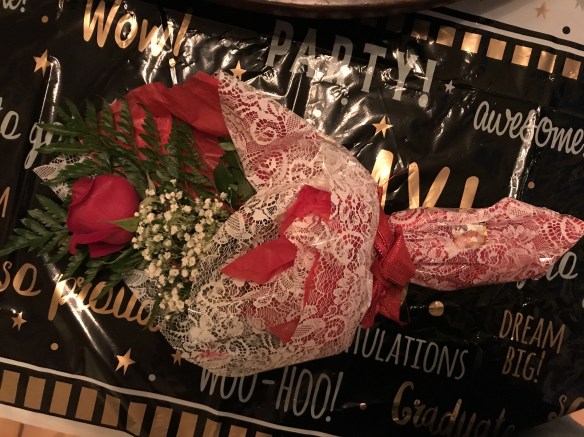
IMG_3378Yesterday my oldest son graduated. What does that have to do with writing and my blog? You’re right. Absolutely nothing.

Except.

Except I didn’t start writing seriously until I became a mother. I will not presume to speak for all women, but my creativity is, I think, closely linked to my maternal drive. After all, I’d never had less time to write than after I became a mother, but since then I’ve written thirteen novels. And, interestingly, I have seen my writing grow, not just quantitatively but also qualitatively, with my children.

Other than that, what does my son’s graduation have to do with my writing. Probably nothing.

Except.

Except now he’s old enough to—if he wanted—pick up one of my books and start reading. He’s certainly old enough to run into someone else who’s read my books or to have a friend who, out of curiosity, picks up one of my books to read. It’s a half frightening thought. I don’t write or publish anything I am ashamed of having read, regardless of by whom, but it’s always a possibility that anything I put out there will change someone’s perception of me. And that’s now a possibility I have to face with my child.

Other than that, surely my son’s graduation doesn’t have anything to do with my writing. Right?

Except.

Except I can’t help wondering how it will sneak into my writing. I often find my life events do. Especially emotional ones, and this one is a doozy. How does the love between a parent and child change when a parent has to face that the child no longer truly needs her in his day-to-day life? It will surely change, and probably deepen into something I haven’t yet experienced. Since I write about love, this will probably factor into my writing in ways I cannot yet predict.

So, while I look back on my past writing with pride and see how it matured with my children, I also face forward and embrace the changes yet to come.

And speaking of changes…

Screenshot 2018-06-03 10.53.37

Coming soon

Poem: Alternative Anthem

united states of america flag

Photo by Gerritt Tisdale on Pexels.com

Alternative Anthem

By Michelle Garren Flye


Oh say, can’t you see

In the day’s last blue light

That our country has bailed

And the darkness is looming?


What good are stripes and little stars

When we don’t do what’s right?

And our laws are all botched,

By our government’s scheming?


And the lies that we’re told

Well, they’re really getting old!

And there’s proof of what’s right

But we must stand up bold.


Oh say, can’t you help me raise a flag we can praise—

O’er a land of truly free and a home to all the brave?

For Santa Fe High School…and all the others we’ve failed since Columbine

As a parent of teenagers, my heart breaks at these high school shootings and the texts exchanged between parents and children during them. In a way, this is found poetry, based on actual text messages, though I changed the wording so it could be between one parent and child. Please, please, when November comes, think about how long it will be before you are the one who receives that first text followed by the next desperate If-I-die one.
A Last Tenuous Connection
By Michelle Garren Flye
Someone shooting in the school.
I love you.
I’m coming.
Don’t. We’re on lockdown. You might get hurt.
My teacher is dead.
OMG. Stay quiet. Stay safe. On my way.
If I don’t make it, I love you and thank you for everything.
Don’t talk like that.
I’m so scared.
I know you are. I’m almost there.
No matter what I love you.
I love you too.
I’m here. Where are you?

Poem: Standard Haiku

I never really claim to be a poet, but I like writing poetry. I love haiku. Its beauty is in its simplicity. A rigid format that nonetheless lets you play within the boundaries.


Standard Haiku

By Michelle Garren Flye


We once held the Truth,

It squirmed away, leaving just

A bloody remnant.


Better than Justice,

Who left us what we didn’t

Use—her blinded eyes.


Oh, Morality!

What have you become? Twisted

Past recognition.

Jesus Walked Into the Waffle House

Between sexual harassment and racial discrimination, it sometimes seems as if our nation is tearing itself apart at the seams. I wonder if we stopped and looked at the other person’s point of view if we’d see how these things happen—not planned violence or gangs or murder or anything truly evil, but the moments of passion that humans get carried away by. The moments when our failings all add up and someone suffers for it.

I wrote this story in response to several news stories. It might not be popular among those who think every choice they make is the right one, but try to see our world as Jesus, who—according to every Bible story and every preacher—loves us all, would. (For another Jesus story, you could try Jesus Walked Into Planned Parenthood.)

Jesus Walked Into the Waffle House

By Michelle Garren Flye

On the night of the local prom, Jesus walked into the Waffle House. He didn’t want waffles or pancakes. He smelled the frying bacon and shook his head. Hadn’t His Father warned them about that?

He smiled at the hostess, an older white woman who worked the night shift so she could take care of her daughter’s two fatherless children during the day. The hostess didn’t smile back, but Jesus knew it was because the baby had skipped his nap that afternoon and she was simply too tired to smile. As He walked past her, however, her head lifted and she straightened her shoulders. As if she felt a surge of strength to carry on.

He moved peacefully into the dining room where a trucker sipped coffee and thought about his family at home. His wife was pregnant and her father had just gotten sick. The trucker worried that the stress would be too much for her. Jesus laid a hand on the man’s shoulder. “She’ll be all right.” The trucker looked up and nodded. He had faith but sometimes it was sorely tested.

The waitress was taking a break. Her feet hurt. She’d already worked six hours when the manager asked her to work another shift. But she needed the money. She had tuition to pay and no one to help her. She wanted nothing more than to graduate and really get her life in order.

Jesus leaned on the counter beside her. The manager came over. “There’s some prom kids outside. We’re likely to have a rough couple hours of it.” The manager saw prom kids every year at this time. Sometimes drunk or high—and always rough and rude—they often came to the Waffle House for a late night snack after prom. The very thought of them exhausted him. He shook his head and muttered, “Two a.m.? Those kids should be home.”

Jesus knew he couldn’t stop what was going to happen. He could see it now. The manager’s daughter had been raped once and he felt protective of the young waitress who was just trying to make her life better. When the young black man dressed in his prom tux complained about the food to the waitress, the manager would interfere. The black man, who was still young enough to think every choice he made was the right one, would reply, rude and indignant that he had been challenged. The trucker, still worried about his wife, and the hostess, tired and thinking of her daughter and grandchildren, would call the police at the first signs of trouble, long before anyone could calm down and think about what they were doing.

And when the police arrived, a pissed off cop would see a sobbing young white waitress and an angry black boy surrounded by the patrons and employees of the Waffle House, all arguing. And the cop would direct his own anger—born of years of these kinds of nuisance calls—at the boy. The boy whose grandmother was so proud of him for his last report card, and whose teachers had promised he would do great things. The boy who wanted to go to college and get an engineering degree, but who had made a bad choice by smoking a joint behind the gym at the prom and now felt invincible.

Jesus could only watch as the cop proved he wasn’t.