The Blank Page in 2015

IMG_5147A new year started at midnight and I was up to let it in. I have this tradition of “letting in the new year.” My husband laughs at me, but every New Year’s Eve as soon as it strikes midnight, I open the front door to take a breath of the fresh air of a fresh year. A year in which I’ve made no mistakes.

It’s exciting and frightening at the same moment. Like a blank page on a computer screen.

I’m sort of in between projects right now. I’ve got several started but haven’t been able to commit to one idea since National Novel Writing Month ended successfully for me in November. I tell myself it’s okay. There’s nothing wrong with taking a break, especially after such an intense exercise as writing 50,000 words in 30 days. But the truth is, when the words don’t flow, I get spooked.

That’s when the self-doubt begins. Maybe I never was meant to write, anyway. Maybe I’ve been wasting my time. Time I could have spent with my kids, but instead I sat in front of a computer. Dreams of being a successful writer–dreams I’ve had since I was seven years old–seem trite when the words won’t come.

But I know they will come. It’s like building a fire without kindling sometimes. Try as you might to light a green log without kindling, it won’t catch fire. So you add some. A few words, an outline, writing a scene…you throw all that into the mix until something sparks and suddenly the story takes off. The log catches fire.

Happy New Year, everyone. Here’s to a word-filled, successful year for myself and all my friends, whether they’re readers or writers. Let’s embrace the blank page with all its fearsome possibilities. It’s only as terrifying as we allow it to be.

At the crossroads of Here and Here for Now

I always get a little introspective at the end of the year. I could look at this year in a multitude of ways. Definitely as a success, as my three growing, amazing children, two new novels and happy homelife can prove. Definitely as a year of personal growth. I hope I’ve learned as much about forgiving and becoming less selfish this year as I think I have. I’m reading more. I’m writing when I can. I’m in a good place.

It’s a comfortable way of being, this being Here. It’s contentment and happiness. I’m happy with Here. But I’m becoming aware that Here is slowly changing to Here for Now.

Subtly different, Here for Now acknowledges that Here is more than a simple point on the map. It’s a point on the map with roads leading away in all different directions. Here for Now allows that change, while slow coming, is always a possibility. And Here for Now is where I’ve decided to be.

I’ve noticed some differences in my writing recently. I’m no longer content to write simple romances where the romance is the final destination, in essence a fairy tale. I want more for my writing and my readers. So I’m Here for Now, but I’m reaching for that more. I’m hoping for change and I’m working toward it, even if it means slowing down and taking better stock of what I already have.

Life as a Self Published Writer and the Road Not Taken

Tomorrow morning, Island Magic goes on sale. My tenth book (nine novels and a novella). It seems like a good point in my career to sit down and look at the road I didn’t take for a minute.

I see the roads of Self Publishing and Traditional Publishing like this. Self Publishing is a rural route. Part of it isn’t paved, and part of it is freshly hacked out of the forest undergrowth. It’s windy and long and sometimes difficult to get through, and there are a lot of little side paths you might find yourself on if you’re not careful. Traditional Publishing, however, is a highway. Well-paved, but sometimes jammed up. Littered with rejection letters from editors, publishers and agents. It’s only once in a great while that a writer can make their way through the pack and over the bridge and into the big, golden city named Published. And once you do, you have to go back to the beginning and start all over.

I reached the fork in my road a while back. Traditional publishing had paid off only mildly for me (two ebooks with Lyrical Press and one with Carina Press). I tried self publishing with my book, Weeds and FlowersMH900058885, because I had literally no idea how to sell it. It isn’t literary or genre fiction. It’s fairly intense for young adults, but the main characters are teenagers. I tried to rewrite it as a young adult romance, but that didn’t work. So I self published it, telling myself it wouldn’t hurt anything.

And it didn’t hurt anything. But it opened up a whole new world to me. Suddenly I realized, as a writer, I don’t have to sit in a traffic jam on the Traditional Publishing Highway. I don’t have to spend my precious writing hours anguishing over cover letters and synopses. If I took this exit onto Self Publishing Route, I could spend them writing what I want to write. Books.

I can still see Highway Traditional Publishing. It crosses Route Self Publishing from time to time. I check out the market, consider submitting, wish for a moment that life could be easier, that my books would sell themselves. And then I continue writing. Because that’s what I want to do, and if I have to pull out my machete and hack my own way through the wilderness, so be it.

Island Magic goes on sale tomorrow. Don’t forget to buy your copy of my seventh self-published book.

Island Magic: Let it go…unless it’s a misplaced comma.

commaThis is the story of how a misplaced comma very nearly brought down all my plans to publish Island Magic on time. Okay, maybe not really, but it did cause a very frustrating morning for me.

I spotted the comma in one of my “extra” rounds of editing. I call them “extra editing” but I don’t really have a name for them. It’s what I do when I’ve finished all the other rounds and want to spend a few minutes re-reading and admiring what I’ve done. “Patting myself on the back” doesn’t sound as good as extra editing.

And what I definitely do not expect is to find a mistake. A glaring error. An imperfection in the form of a tiny, itsy bitsy punctuation mark…a misplaced comma.

THE misplaced comma.

I knew immediately where this comma came from. It was stuck in the middle of a sentence between the subject and verb. How on earth did I do that? In no realm of alternate punctuation would I ever think a comma belonged in that spot. But in this particular instance, it was a sentence I’d rewritten on my last pass through the document. I rewrote the sentence because it struck me on that last pass as being too long and complicated. I deleted a clause, but somehow I neglected to delete one of the commas that went with it.

But what to do about this comma? I could leave it. Everything else in my document was perfect. At least as far as I’d seen. But I knew that comma would haunt me. I couldn’t let it go.

So I opened up the document and fixed it. Then I downloaded the fixed file to Createspace and KDP.

That’s when I noticed a mysterious tab had appeared on the left side of most of my document. Where it came from I didn’t know, but it definitely threw off my page count. Which threw off my cover. The tab had to go. Unfortunately, not only was it a mysterious tab, it was also a stubborn one. No matter what I did, it remained.

And then, as suddenly as it appeared, it disappeared. Taking with it all of my formatting. Line spacing, first paragraph indent and all chapter headings and scene break indicators (you know: ****).

During the course of the morning as I fixed the missing and messed up formatting, I cursed myself for ever touching that comma. Really. It was like a zit on your nose that you squeeze and make a big red mark instead. About fifty percent of my readers would never have even noticed that comma zit and forty-five percent of the others wouldn’t have cared. I can only think of a couple who’d ever have mentioned it to me.

I’m not really certain what my take away from all this was. I’m not the type to ignore little zits, even if messing with them causes bigger problems. But the end result, I hope, of striving for excellence is at least a step closer to it.

What about you? Do you let the little mistakes go or are you willing to cause bigger problems to fix them?

What’s in a Cover, or How Writers Judge Books by Them

We writers are very silly people. We show pictures of our covers the way proud parents show pictures of their babies. In most cases, we’re no more responsible for the way the cover looks than the funny expression captured by a snapshot of a baby. But that doesn’t matter. It doesn’t affect our pride in the first concrete proof that our work has paid off.

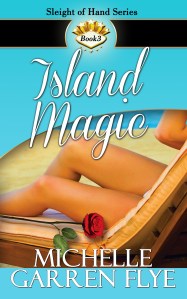
Congratulations. It’s a book. Island Magic eBookAnd yet. When an author looks at a book cover–whether they designed it themselves or had someone like the fabulous Farah Evers do it for them or got it straight from the Art Department of Harper Collins Publishing–however that cover came into being, when an author looks at it for the first time, it’s going to be one of two things: a huge disappointment or the culmination of every dream the author ever had for her book.

As an independent author (I like “independent” much better than “self-published”), I have a bit more control over things, so I don’t often get one of those huge disappointment things anymore. In fact, as you can see above, my most recent cover falls very definitively into the latter category.

I’ve been working on this story for a while. Ever since Escape Magic, as a matter of fact. Island Magic was a tough story to write. It deals with some more difficult themes than either of the first two books in the series. However, I didn’t want it to lose the magical feel of the first two books, and I wanted my cover to reflect that. With the help of Ms. Evers, the cover did indeed come to life with all the magic and beauty of the first two. And a little indefinable something more, too. This cover is perfect for this book.

So forgive me if I start featuring the cover prominently on my blog so early. The book won’t be published until October 31 (Harry Houdini’s birthday!), but you can pre-order it now for your Kindle. 

One Thing Writers Never Tell You About Writing

When people find out I write, they ask me, “What’s that like?” Usually I’m at a loss. Writing is so much a part of me and who I am, I can’t really separate it enough to look at it. All I can come up with as a reply, usually, are amorphous answers that I’m never certain of so I always word them almost as questions. “It’s…uh…fun?”

Recently I dug a little deeper. I was actually trying to remember what the last book I read was—other than my own—and how I used to love reading. It drove me nuts to be caught somewhere without a book. When I was a kid in school, I was always the first one to hand in my math test and then I’d pull out whatever novel I was currently reading (or re-reading). And get lost in it. Remember that old line by libraries and teachers and literacy organizations, “Books take you places”? When I was a kid, books took me all over the world.

And now that I’m an adult and a professional (albeit only marginally successful) writer, I realized something that nobody ever told me before about writing. When you write a book, it takes you places, too.

Only it’s better.

Yep, that’s what it’s like to be a writer. It’s like being a reader, only better. Yes, it’s hard work. There are days I despair of ever writing two coherent words in a row. There are days when writing sentence after sentence is more arduous mentally than plowing a field with a mule and a hand plow is physically. Writing can be so exhausting it’s frightening. It can hurt. But it’s good. In fact, it’s wonderful.

It takes you places.

I’ve set my books in places I’ve never been like New York (I’ve been twice since, but I’d never been there before I wrote Secrets of the Lotus) and Greece (part of Saturday Love). And I’ve set them in places where I’ve been and long to go back like the Caribbean in Island Magic and Las Vegas (Close Up Magic and Escape Magic). And I’ve set them in places I’ve lived like Hillsborough, N.C. (Where the Heart Lies) and my hometown of Brevard, N.C. (Tracks in the Sand). And each and every time, when I would sit down to write, my book would take me there.

So now I guess I have a reply. “What’s it like to write? Why do I do it?” Because writing is like reading. It takes you places. What makes it better is that you get to take your readers along with you for the journey.

Why rewriting might be easier for a “Pantser”, or the joy of the honeysuckle rose.

I’m a “pantser” (as in fly-by-the-seat-of) when it comes to writing. And everything else in my life. Anybody who’s ever tried to set up a playdate with my kids knows I don’t plan ahead. The best way to make plans with me is text me at the last minute. If I’m not doing anything, I’ll probably join you. On the other hand, I hate birthday parties. Trying to figure out what me and my kids are going to be doing two weeks from next Saturday at three o’clock in the afternoon? Ha! As if.

When it comes to writing, “pantser” (and I really prefer the term “organic writer” and please don’t call me a “paNSter”) means one simple thing. I don’t outline. I plunge in with a vague idea of where I’m going and who I’m going with (my characters) and plow through until I reach the finish line. Which is usually not where I thought it was when I started out. Which usually means I have a total mess to go back through when I’m done.

So why do I think rewriting is easier for me than someone who has plotted and planned and checked out every intersection of the race? (Ahem, not that writing is a race. It’s totally not.) Because, to move from racing to gardening metaphors, I don’t mind throwing out and cutting and replanting. Just for instance, a first reader told me a few months ago that the story I was telling in my current work-in-progress wouldn’t work. She had some great points, including the fact that my heroine was totally unsympathetic. (I’d been going for tough.) She made some suggestions for a total rewrite and I set the work aside for a few weeks. Now, coming back to it, I’ve got fresh eyes and I’m pulling weeds like crazy, trying to get at the heart of the novel.

What I’m getting at is that it’s not that abnormal for me to throw out three thousand words at a chunk. I may have spent an entire working day composing those words, but if I find it’s a weed and not a flower (haha), I don’t mind tossing them at all. But what if I’d plotted and planned and written those words and gotten the same reaction from a first reader? I don’t think it would be as easy to pull and prune and toss.

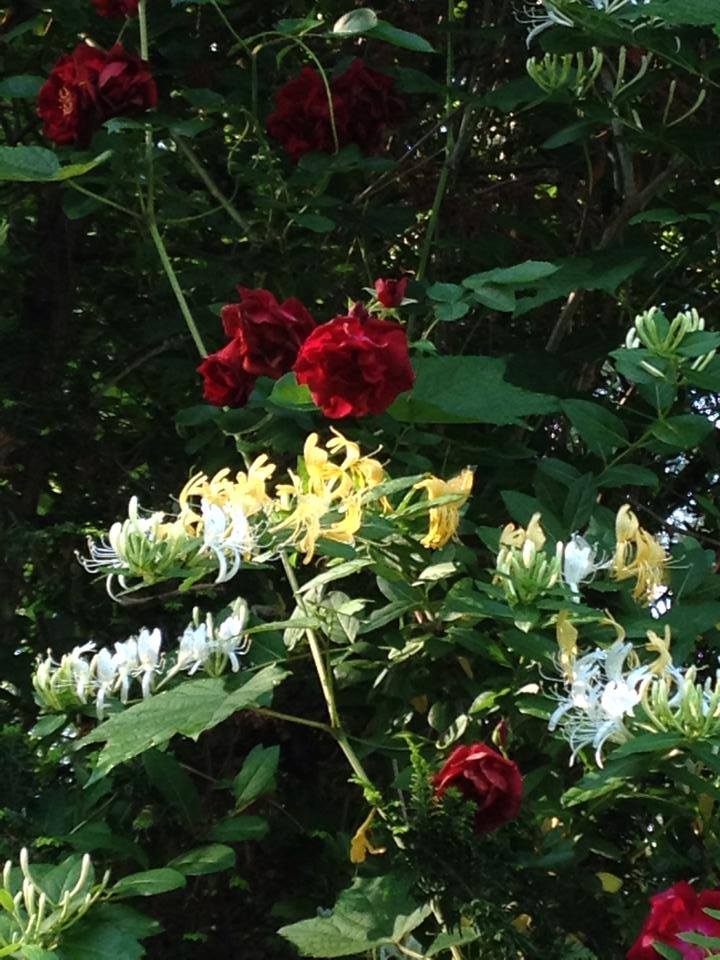
But then, if I planned and plotted, maybe the finish line would stay where it was supposed to be, huh? Just like a well-planned garden. But then I might never get a chance to find something like this:
honeysuckle rose

And that’s the true joy of being a pantser. Finding the heart in the middle of the massive mess of writing. A honeysuckle rose that nobody planned. Because there always is one. Even in a novel you have to completely rewrite.

I finally got it right! (Preview excerpt from ISLAND MAGIC)

I’m so excited! After working on Island Magic for at least the past six months, rewriting and then rewriting again when I hit wordblocks (ha, see what I did there with roadblock/wordblock?), I think I finally got it right! I have a really good feeling about this particular iteration of my latest in the Sleight of Hand series. At times I’ve even had to wonder why am I tearing my hair out over this story? Maybe it just doesn’t want to be written. But I do think it does want to be told. I just had to find the right way to tell it. And today, I hit on it. And because I’m so confident I’ve got it right and so excited about what I think the changes are going to do to my story, I’m going to give you a little preview!

The first few paragraphs of ISLAND MAGIC:

Even Logan didn’t expect magic that night, but when he thought about it later, that was the night the real magic started.

Night fell slowly in the Caribbean, and when it came, it was complete. Especially in the little bar on the beach that Logan loved. Even the tiki torches only spread small radii of flickering glow around their poles. The rest was dark, secret, a haven for those who would rather not be seen.

From his oasis behind the thatch-roofed bar, he watched the patrons of the resort milling around, coming in from the dark beach, usually hand-in-hand with someone else. Occasionally a group of young men would collide with a group of young women and soon they would pair off and head into dark corners. All Logan had to do was make their drinks and chat. No interference required on his part. He was like a voyeuristic benefactor, watching them leave his bar with nothing but good feelings.

He spotted Rachel in the bar, but he lost sight of her in a crowd of college kids. He frowned, craning his neck. It certainly had looked like Rachel. Nora’s best friend, the maid of honor at his wedding to a woman who was now dead. But what would Rachel be doing there? And why wouldn’t she have told him she was coming?

He recognized the long, luxurious hair and the lovely features, even though they had a hard edge he wasn’t used to seeing. And what was up with the slinky dress? Rachel had always seemed so strait-laced he’d figured she would be a suburban soccer mom by now, though he’d lost touch with her years before. This was no soccer mom. This wasn’t even the beautiful, gentle woman Nora had known in the years after their marriage.

As he spied, she sat at a table not far from the bar. She was alone, but everything about her said she had no intention of remaining that way. Logan noticed several men glancing her way. He couldn’t blame them. Her raven hair fell over one bare shoulder, her sleeveless red sundress setting off her tan. He couldn’t take his eyes off her, and he shouldn’t be looking at Rachel that way. Not Nora’s best friend. Never mind that Nora died eight years ago, his self-imposed exile hadn’t been long enough. He needed more.

When the waitress delivered her order for a frozen margarita with salt, Logan intercepted it from Ramon. “Sorry, man.” He grinned at his friend. “I’m gonna deliver this one personally.”

Ramon gave him a mock growl. “Earn me a good tip if you’re gonna pull rank on me, amigo.”

Logan flashed him a smile and vaulted the bar neatly, landing on the other side to appreciative looks from a group of young women. He saluted them, picked up the margarita and crossed to the table. “Your margarita, señorita.”

She raised beautiful dark eyes to meet his. God, he’d always known she was beautiful, sexy, desirable, but the raw sensuality in that gaze left him breathless. She smiled, playing along as if she had no idea who he was. “Muchas gracias, señor. To what do I owe the special delivery?”

He glanced left and right, then sat across from her, leaning over the table as if to keep their conversation covert. “Between you and me, I’ve been told I’m overly concerned with our guests’ satisfaction.”

The curve of her lips deepened and he knew she’d sensed a double entendre in his words. He wanted to laugh but didn’t give in to the impulse. He’d spent so many years on stage, his career so dependent on reading his audience, yet he couldn’t seem to see Rachel’s carefully guarded exterior anymore. It intrigued him enough so he stepped over a boundary he hadn’t crossed in years.

Leaning over the table, he beckoned her closer. When she obliged, her expression highly amused, he let his lips brush her ear. “Do you believe in magic?”
Just a funny little story about the truth behind dishonesty.

I’m very busy right now writing Island Magic, the next in my Sleight of Hand series, but I wanted to take a break and tell you a story (almost entirely true, I swear) about something that happened to me this weekend.

First of all, meet Freddy, my Yorkie. He’s my life coach, my best friend, and, at times, my muse. Or at least he lets me bounce ideas off him when there’s nobody else around to listen. Freddy doesn’t say much, but he does let me know when it’s time to take a break, and I’ve found my walks with him can help clear the fuzzies out of my head better than just about anything else.

On one of these recent walks, Freddy and I are walking along minding our own business when a woman we’ve never met suddenly greets us with great enthusiasm.

I admit, I wasn’t sure she was talking to me. Freddy’s the one who attracts the most attention on our walks. And even I am bad about looking at the dog before I look at the owner most of the time. However, this woman not only waved and called, but actually crossed the road to speak to us. Okay, I’m bad with names but I’m not bad with faces, and I was pretty sure I’d never seen this woman in my life. I shot Freddy a suspicious glare and he protested his innocence by barking and sniffing the woman’s feet.

“Oh my, she’s getting big, isn’t she?” The woman laughed at Freddy’s antics.

Okay, that settled it. The woman didn’t know us. Freddy’s all boy except he’s been snipped and doesn’t really think of himself that way anymore. But what was the harm in letting the woman call Freddy a she? It didn’t bother me. It didn’t bother him. And we didn’t know this woman anyway.

In spite of this, we chatted a good two or three minutes before I finally made motions to leave. At this point, the woman taught me a valuable lesson. Making a face, she said in a confidential voice as if talking about something shameful, “You know, there’s a little boy Yorkie in the neighborhood too.” She peered at Freddy as if afraid he’d grow little boy parts. Then she nodded, satisfied. “But she just looks like a girl.”

Honestly, I could have sunk through the ground right then. Half of me wanted to own up to the fact that I’d basically lied to her the entire time we’d been standing there discussing Yorkies. The other half was terribly afraid she’d be mortified by her mistake. Escpecially after she’d pretty much let on that little boy Yorkies were something distasteful. I managed to make my escape much more gracefully than normal, however. “Well, after they’ve been fixed, it really doesn’t matter much, does it?” I laughed and waved and fled, Freddy in tow.

Being who I am, of course, I made the whole incident up into something quite philosophical by the time I got home. If I’d gently corrected the woman in the beginning, I might have avoided that particular awkwardness, and, I wondered, were there other aspects of my life I could apply this to? If I start out right on other things, will it finish up better? I’m always telling my kids that we follow rules—even those that we see other people breaking—because we don’t want to make the people around us feel badly.

Maybe I need to follow my own advice sometimes.

The Spider and the Squirrel: When Best Laid Plans Pay Off…and When They Don’t.

Since obtaining a small dog minion who must be walked every hour and a half, I’ve discovered something surprising. I live in the woods. Yeah, you’d think I would’ve noticed that, wouldn’t you? But when you’re “walking” a Yorkie, you see things a little differently, mainly because there are a lot of starts and stops and while he’s sniffing around for a good place to go the bathroom, you actually get a chance to look around a little bit. Yesterday I spotted something very cool. It was a spider web. Being a romance writer, I’m probably a little more, well, romantic about this sort of thing, but I was very impressed with that spiderweb, which was perfectly circular in the middle but had long strands stretching from trees on one side of my driveway to the other, a span of about twenty feet.

I started thinking about the planning that no doubt went into that web. Did ever an architect plan a skyscraper more intricately? And what about that perfect circle in the middle of it? Just looking at it took my breath away.

That’s when I decided I need a plan. I’ve got so much going on in my life right now. Wonderful stuff, but it does distract from my writing projects a bit. I have three books in various stages of being ready for reader consumption. I need a schedule. So I made one, and I’ll share it with you in just a sec. But first I have to tell you about the other little lesson nature taught me.

It was a squirrel this time. We have a lot of those and at this time of year, they go a little crazy hopping from one treetop to another. They can practically fly, or at least they appear to…ahem, most of the time. This morning, I watched as one jumped from one tree to the next, ran up a branch and jumped again…and fell flat on his face. That fall must have been forty or fifty feet. I actually felt the earth tremble as its little body hit the ground. Imagine my amazement when that squirrel not only got up (after a stunned second) but raced back up that tree, pausing to scold me on the way for seeing his embarrassing slip.

So plans don’t always work out. You don’t always end up with a glimmering gossamer masterpiece. Sometimes you fall flat on your face. The important thing is to get back up and keep trying. With that in mind, I’m announcing a tentative publishing schedule for my next few books:

October 31: Escape Magic (book 2 in the Sleight of Hand Series)
January 1: Saturday Love (sequel of Ducks in a Row)
March?: Island Magic (book 3 in the Sleight of Hand Series)
June/July: Agapi Mou (sequel of Saturday Love)

Please don’t judge me too harshly if this schedule is adjusted over the coming months. Agapi Mou (which is Greek for My Love) isn’t even written yet, although it is an extension of a short story by the same title. Looking at this schedule now, I’m fairly confident I can manage it. But then, I’m pretty sure that squirrel thought he could make it to that next tree, too.