March is Women’s History Month

March is Women’s History Month. How many of you knew that? I’m thinking fewer than should. We all know Black History Month is February, and many of us know April is Poetry Month, but for some reason Women’s History Month isn’t well known.

I’m thinking it may be because so much of women’s history isn’t known. It’s been suppressed in favor of men’s account of women’s history. I found it interesting, for instance, when I happened upon this little tidbit of women’s history on a trek around my hometown:
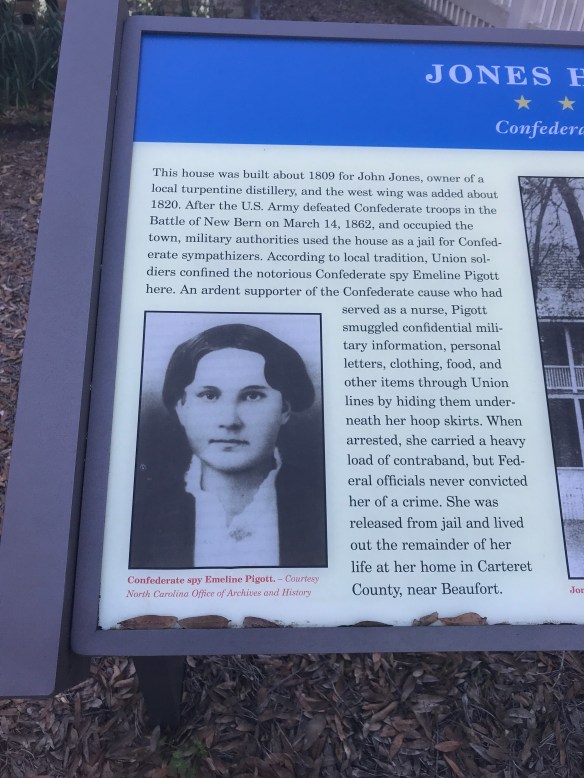
I did a little research on Emeline. Her name is alternately spelled Emmeline and Piggott or Piggot or Pigot or Pigott—even once in a newspaper clipping about her arrest “Eveline”. There are many stories about her, including that she “entertained” Union soldiers while her brother-in-law carried contraband to Confederate troops, that she ate a letter when she was arrested instead of turning it over to Union soldiers, and that while she was jailed an attempted assassination by chloroform failed because she broke a window to breathe through until help arrived.

It’s interesting to me because in some places, these stories about Emeline are referred to as legends and in other places are reported as facts. Even here on the sign, it says “According to local tradition”. That’s almost equivalent to “Once upon a time”. But Emeline was not a fairytale. She was a real woman, and, regardless of politics, she suffered for a cause she believed in.

It got me thinking about what women went through to get the vote. Until a few years ago I’d believed they marched peacefully, well-dressed and carrying banners because that’s what the school history books depicted. The reality is less appetizing, though. A few years ago I read about “the Night of Terror” when suffragists were beaten and tortured. A little shocked, I did more research.

Suffragists were badasses. Seriously. They didn’t just stand around with polite placards saying please let us vote until reasonable white men decided to give them the nineteenth amendment. There was property damage, rude signs and screaming at the president and Congress. Incarcerated women went on hunger strikes and were force fed with rubber tubes.

No doubt they were told at some point not to be so emotional.

I wonder if today’s men would dare to tell them to “smile more”.

My point is, you won’t learn about most of women’s history in schoolbooks. “Women held protests on the White House lawn and were given the right to vote in 1920” is about all you’ll get there. What women need to remember is that for decades women fought for the right to vote. They fought with much more than just orderly parades and when saying please failed, they didn’t hesitate to declare all out war.

Should we allow that history to be repressed? Shouldn’t we be teaching it to our daughters?

Infamous suffragist leader Lucy Burns, on the third day of a hunger strike following her imprisonment on the Night of Terror, was tempted with fried chicken to break her strike. With contempt, she said, “They think there is nothing in our souls above fried chicken.”

There is so much more in the soul of women than what we’re given credit for by the history in schoolbooks. I may not agree with Emeline Pigott’s politics, but I do think she carried iron in her soul, and I believe she deserves the credit for that. Her story should not be relegated to the same level of history as fairytales. Whatever happened to her while jailed, or while she was “entertaining” Union soldiers, it is part of women’s history and women’s history isn’t fried chicken. It’s iron and blood and suffering and triumph. And we should never forget that.

Crazy Little Thing Called Love (with a poem)

Happy Valentine’s Day! A day dedicated to this crazy thing called love.
But why “crazy”? you ask. What do you mean by that?

Because nobody knows what causes it. And you risk ruining it by examining it too closely.

Because what else could it be but crazy to open your heart and show someone else what’s in it?

Because loving someone—or something—is the biggest risk you can ever take. If they don’t fail you, the world might. Life happens all around us every single day. And it happens to all of us in different ways all at the same time.

Because if you let love into your heart, it will take up all the space there—and if life happens to the subject of your love in a way that takes it away, the emptiness might just become a black hole that sucks you into the void.

So why, then? If it’s such a big risk, why do we do it? Why do we search for love? Why do we willingly plunge into the risky waters of love?

No one knows. And certainly no one knows better than the poets that no one knows. In his aptly titled poem “Poem”, e.e. Cummings said:

love is the voice under all silences,
the hope which has no opposite in fear;
the strength so strong mere force is feebleness:
the truth more first than sun more last than star

I like this and I feel like it comes closer to identifying the what and the why better than anything I’ve ever read. It’s like “The Force” in Star Wars. Love underlies everything, is everything, the one superhuman strength that you can’t really identify but it’s really there. It makes us stronger and weaker at the same time.

Love—whether it’s for parent, sibling, child, spouse, pet or all things—is the way we connect most intimately with the world. The more we feel, the closer we are to the universe. The more we open ourselves up to love, the more risk we are willing to take for the love—the more fragilely strong we become.

A Million (and 1) Things to Love

By Michelle Garren Flye

Where is love?

Songs simplify,

Poems complicate.

But love is there.

Reach for it.

The love of saving,

The love of believing,

The love of finding.

Love fleeting,

Love flying,

Love staying.

The world is full.

All around you, things to love.

Objects for affection.

A cat, a dog, a child.

A rose, a plant, a sunset.

A soul mate for the very lucky.

Hope will find love.

Trust will strengthen love.

Faith will keep love safe.

Reach for it.

Hold it tight in your heart—

And hope it doesn’t

Break

You

Open.

Poem: Pinned

Pinned

By Michelle Garren Flye

Pins hurt, I remember. Pins stick in your skin when you put on a new shirt without checking. Crimson stains on ivory.

Why pin each other, then? Why pin those we love? Stay here. That’s your spot.

It hurts.

Why pin those unlike us? Stick them with scarlet letters. You’re not us. Stay away.

It hurts.

We do it anyway. Jab into flesh until blood comes. Pins like Judgment, like nails on the cross. Us. Other. With us, against us. Pins line up, sharpened stakes to keep us in or push us out.

I hold one in my hand, a dagger to slash and judge. Watch. The blood waits, pulsing, just beneath the sin.

Poem: For Tom (broken)

One of my heroes made the news for the wrong reasons this week, bringing home to me that all of us become less relevant as we age. Even the great ones.

For Tom (broken)

By Michelle Garren Flye

Don’t speak too loudly.

Stay out of their way.

Their edges are sharp and they will cut you,

Force you to retreat, retire.

Your own edges are worn—

Who is impressed by Woodstock anymore?

You didn’t win your wars.

Vietnam, civil rights.

Even the drug war is left for this generation to fight.

Compassion is round

In your hands, but

It turns flat in theirs—and shows only one side.

That side has edges

And they are used to cut.

So be careful, stay silent, keep clear and beware.

For the round and the soft,

The worn and the frayed

Have no place in the edgy world of the young.

Despairing of Toxic Humans

He’s witnessed a lot. What would his social media status be?

Albert Einstein said, “We cannot despair of humanity, for we ourselves are human.”

Of course, Al didn’t live in the age of social media, did he?

By now, everyone has seen video of the MAGA hat-wearing Catholic kids making fun of the Native American elder who may or may not be a Vietnam veteran. And everyone has an opinion. Some say the kids are at fault, others the African American men who hurled insults at them because they were wearing MAGA hats.

Personally, I find fault with everyone involved in that situation, including myself. And I was several hundred miles away when it happened.

Just to be clear here, the kids from Covington Catholic were absolutely behaving badly. Toxically. Their parents should ground every last one of them for disrespecting their elders.

With that said, however, those kids were mirroring not only what they were seeing right then, but also, probably, what they see at home and at school. The evidence for this? The chaperones did not interfere. By not interfering, they okayed the behavior of these kids. I’m not sure why anyone is surprised by this. They are from Kentucky, the lovely state that gave us Turtle Man McConnell, the most toxic human being in government.

Add to that the horrible behavior of the other adults on the scene, and you can see what these kids are up against. And then some idiot adult edited the video to make it look like the teenagers were the only ones misbehaving and idiot adults like me were outraged and posted and reposted on social media.

The truth of what happened on the steps of the Lincoln Memorial is that everyone was behaving badly. There are no martyrs here. And I really wish the adults would own up to their bad behavior and set a better example, because condemning kids for following the super bad examples they see from adults is going to get us nothing but more toxic adults.

Of course, Einstein also reportedly said, “Two things are infinite: the universe and human stupidity.” So maybe I shouldn’t hold my breath where humans are concerned.

Poem: No Pain (for the Jerks)

No Pain (for the Jerks)

By Michelle Garren Flye

It’s little things.

Playground things.

A hard bump

Instead of a pass.

A mocking word

Like a tiny barb.

A whisper, a lie,

A rumor spread

Like stinky cheese

On a wilting cracker.

It’s dumb things

That shouldn’t matter.

A missing invitation

To a birthday party.

Picking me last

For every team.

Just bullshit really.

Nothing that hurts.

You can’t make me cry.

I’m too tough for that.

I don’t cry when

The leaves fall.

I don’t weep when

Rain thunders down.

I don’t mourn the

Wilting dead flowers

By the walk.

How could neglect

Pierce my heart, then?

Why would contempt

Cause me grief?

Or cruelty sadden me?

I feel no pain.

I feel nothing at all.

romance, author, writer, photography, love

“Reflection” Photo by Michelle Garren Flye

Poem: Magnum Opus

“If people knew how hard I worked to achieve my mastery, it wouldn’t seem so wonderful after all.”

–Michelangelo


Magnum Opus

By Michelle Garren Flye


Is that your masterpiece?

Your legacy and estate?


When you look at it,

Do you know it’s finished?

Or do you want to wipe it clean?


Completion is nothing.

Finality is all that counts.

You could dot the last “I”—

Then black it all out.


The creator’s Hand decides.

Or maybe it’s accidental?

In the end, it won’t matter.


Shake the Etch-a-Sketch

And start over again.


Author’s Note: As the year draws to a close, I’m looking hard at where I am and where I want to be. I’m making plans for changes. Watch this space.

But don’t worry. I still have plenty of romance left. I’m not erasing the Etch-a-Sketch. I’m adding another one.

No apologies: I write what I write.

close up of tree against sky

Romance is a window on the reader’s soul, not the writer’s. Photo by Pixabay on Pexels.com

It’s a truth for most romance writers, I think. Our friends and family are almost afraid to read our books. As if they might find out something more about us than what they want.

Why don’t you write something else? I have this great idea for a book you could write.

It could be funny.

I could almost laugh.

Why am I amused? The reason is simple. Any good writing lays your soul bare because you do tell secrets about yourself. It’s the only real way to make your writing read true to another person’s soul. The trick is to write it so no one knows what is true and what is fiction. And I can guarantee you, even those who know me best don’t know what’s true and what’s fiction in my books.

I always say I’m never in my books. And it’s true. I’m not a character in my books. But I am in there. I’m in every word and phrase I write. When you hold my book, you are holding a part of my soul. Is it a window onto my everyday wants and desires and loves? No. Like all writing, and especially fiction, my words are filtered through the reader’s experiences and is more likely to reveal something about them than me.

I guess that’s why I say, no apologies. I write what I write. If you  have the courage to read it, that’s great. If not, please understand when I chuckle a little when you suggest I write something different. I love you, but my visceral answer to such a suggestion is an unequivocal “no.”

In other news…

I’m on Book Reviews by Jasmine today promoting Becoming Magic by talking about what I’d do on my day off if I worked in show business in Hollywood. As you might expect, it’s magical!

And on Smashwords and its affiliates, Close Up MagicBook 1 in the Sleight of Hand series, is FREE just in time for the holidays! Read it if you dare!

Like them or not, you should listen to the poets

If anything has caught me off-guard about today’s political climate, it’s the rising dislike of celebrities and intellectuals. Once upon a time, these were the heroes. Movie stars like James Dean smoked, so everyone had a pack of cigarettes tucked in their rolled up t-shirt sleeve. Jane Fonda said we need more exercise so everyone started aerobics. Remember those “The More You Know” PSAs? They featured everyone from Tom Brokaw to Matthew Perry speaking out about issues like conservation and education. Stars trying to use their star status to make a difference in the world.

In 2016, it felt like all that changed. All of a sudden, conservatives wondered out loud where athletes and movie stars and, God forbid, writers got off having political opinions. And why should they be allowed to speak out about the every day world of politics? Movie stars should just act, singers should just sing, athletes just play their sports (and stand for the National Anthem). The other day, Rob Thomas tweeted that he was shocked to see a reporter’s White House press credentials taken away because he asked the president a question the president didn’t want to be asked. The response Thomas got from fans was less than encouraging in many cases.

But the worst of this is that suddenly writers aren’t supposed to have an opinion. Writers aren’t supposed to speak out against what looks like certain doom. Writers shouldn’t remind the public of what has come before and what it wrought. The press is “fake news” because they are trying to report what’s happening to us. This seems a particularly dangerous attitude, honestly. To prove my point, I’ve compiled a partial list of things writers (mostly in science fiction, but not all) predicted, for want of a better word, in their fiction.

And after reading this, maybe you can understand why I say, listen to the poets. Otherwise, you may live to regret it.

1726 (Jonathan Swift) Gulliver’s Travels predicted the discovery of Mars’s two moons.

1818 (Mary Shelley) Frankenstein predicted organ transplants.

1865 (Jules Verne) From the Earth to the Moon predicted solar sails and lunar modules that launch from Florida and return to earth as splashdown capsules.

1887 (Edward Bellamy) Looking Backward predicted credit/debit cards and shopping malls.

1898 (Morgan Robertson) The Wreck of the Titan: Or, Futility predicted the sinking of the Titanic—by iceberg in the month of April—fourteen years before it happened.

1899 (H.G. Wells) When the Sleeper Wakes predicted motion sensing doors.

1903 (H.G. Wells) The Land Ironclads predicted tanks.

1909 (E.M. Forster) The Machine Stops predicted video chatting.

1910 (Edwin Balmer and William MacHarg) The Achievements of Luther Trant predicted the lie detector test.

1913 (H.G. Wells) The World Set Free predicted the atom bomb.

1923 (H.G. Wells) Men Like Gods predicted phones, email and television.

1924 (J.B.S. Haldane) Daedalus; or Science and the Future predicted in vitro fertilization.

1932 (Aldous Huxley) A Brave New World predicted genetic engineering.

1961 (Robert Heinlein) Stranger in a Strange Land predicted water beds.

1968 (Arthur C. Clarke) 2001: A Space Odyssey predicted the iPad and its use to access news media.

1968 (John Brunner) Stand on Zanzibar predicted satellite tv, violence in schools, and, eerily, President Obama (Obomi was the character’s name). Interestingly, it is set in 2010.

1984 (William Gibson) Neuromancer predicted computer hackers.

1990 (David Brin) Earth predicted broken levees in the Deep South and the meltdown of the Fukushima power plant.

1994 (Tom Clancy) Debt of Honor predicted the use of hijacked jet planes to crash into U.S. government buildings.

Donald Trump’s rise to the presidency has been predicted by everyone from The Simpsons to Philip Roth. In Octavia Butler’s Parable of the Talents, her presidential candidate even used the slogan “Make America Great Again”.

Are these all coincidence? Life imitating art? Possibly, though Stand on Zanzibar and The Wreck of the Titan sound like blatant fortune-telling to me, and how Jonathan Swift could know Mars had two moons in 1726 is beyond me. But what is my point here, anyway? Should Stephen King and J.K. Rowling be allowed to say whatever they want about Donald Trump and the fools who voted for him?

Yeah. Probably. Because true poets have a knack for looking at things a little closer, opening themselves up to the universe a little more, feeling things a little deeper…and seeing things a little clearer than others do. I’m not saying me. I try, but I haven’t gotten there yet. But I do believe we are given poets and prophets and visionaries by a God who wants to help guide us.

And if the overwhelming majority of those poets and prophets and visionaries are saying don’t go there, I suggest we listen.

aged antique book stack books

Photo by Pixabay on Pexels.com

I love interviews.

Just for the record. In case you were wondering if you could ask me questions. Because I actually love questions. Even my kids can only wear me down after asking the same question about ten times.

Seriously, though, interviews are fun. Like writing but you don’t have to come up with the idea yourself. I’ve done several interviews on my blog tour for Becoming Magic, and I’ve enjoyed all of them. Today I’m at the lovely Teresa Noel’s blog for another interview. You can find it here: T’s Stuff Interview.

One of the questions Teresa asked me was about my favorite part of the book. I had to think about it, and, I admit, I considered many different parts. I finally settled on one, but I won’t spoil it here. Go check out the interview!

TourBanner_BecomingMagic