Unknown's avatar

About Michelle Garren-Flye

I am an author of romance, poetry, children's books and graphic novels. I also own a bookstore. My love of the written word runs deep.

Pardon me…excuse me…oops. Did I step on your toe?

There is a huge part of writing that no writer enjoys, although without the result of it, we might as well leave everything on our desktop and not worry about sending our words out into the world.

Selling.

Let’s face it. Most writers are not born salesmen. We don’t know how to hawk our wares effectively, and when we try, we’re fairly awkward about it. We don’t want to bug you, but darn it, if we can’t get you to read what we wrote, what’s the point?

Which brings me to my current situation. I’ve written and published five books now. I’ve sent two more out to a publisher to be considered and I’m planning to publish a sequel to one of my self-published books, Ducks in a Row, in the next few months. If all goes well, by next year, I’ll have eight books out there.

So, how do I get you to read them without feeling like a nuisance when I ask? Every time I tweet or blog or post on Facebook about my books, I feel like one of those idiots who shoves her way to the front of a crowd without regard for the feelings (or toes) of those already there.

I don’t have the answers yet. I’m working with a very talented lady who is really trying to help me navigate the Internet and blogosphere with a little more grace, but I still feel awkward about the whole thing. It certainly helps to know I’m not alone out there pleading for attention. Many of my writer friends are right there with me.

And what really helps me is the knowledge that what I’m selling is not necessarily on the same level as Ginsu knives. Like most writers, I’m not in it to make a quick buck. I’m in it to try to keep all my hard work from going to waste. You see, my payoff doesn’t come from selling a book. It comes from you reading it.

What would it be like to be a dead author?

I’ve been needing to update my blog for a while now, but I like to have something to say before I start out and recently my head has been too full of other things to come up with a decent blog post. My mother would say I’ve got too many irons in the fire. The truth is, I bounce from one project to the next and rarely have a moment to come up with something real to say. For instance, this week I’ve been rewriting a submission at the request of a publisher, cataloging library books, updating a Facebook page and trying to keep up with all my other regularly scheduled activities. Add to that my new quest to actually SELL the books I already have published and you end up with a whirling head and no time to BREATHE (pun intended).

Today I stopped for a second while I was working on the library books. I stopped because I had come across a nice little paperback of Joseph Conrad’s Lord Jim. I’ve never read this novel, but I love books in general, and this one had obviously been read. Plus, I’m fascinated by dead authors. What must it be like to die knowing your books are read the world over and will be read for years to come as Conrad did? Hemingway is another one like that. Did he die knowing he was a legend? I’m pretty sure Samuel Clemens did, although he probably figured the joke was on us. And what about authors like Poe who died penniless? Would he feel better about his life knowing his work has lived on as long as it has?

Libraries are full of dead authors, and they’re much more fascinating than the live ones, if you get right down to it. My friend Ellen Meister has a book coming out in a couple of weeks called Farewell, Dorothy Parker that I absolutely can’t wait for. Leading up to it, Ellen has maintained a Facebook page for Dorothy Parker, and it has been fascinating reading. I was never a huge Dorothy Parker fan (and can’t swear I am now, either), but I definitely include her among the ranks of dead authors I’d love to meet. And since I can’t, I’ll just have to read Ellen’s book, a novel about a woman who meets Dorothy Parker’s ghost.

I hope there’s a literary heaven somewhere and I hope Poe is treated with as much respect there as Papa Hemingway. I like to think they all know when their books are read by someone who loves them…or even a high school student who reads it because he has to.

In with both feet and hoping self-publishing isn’t one of the deadly sins.

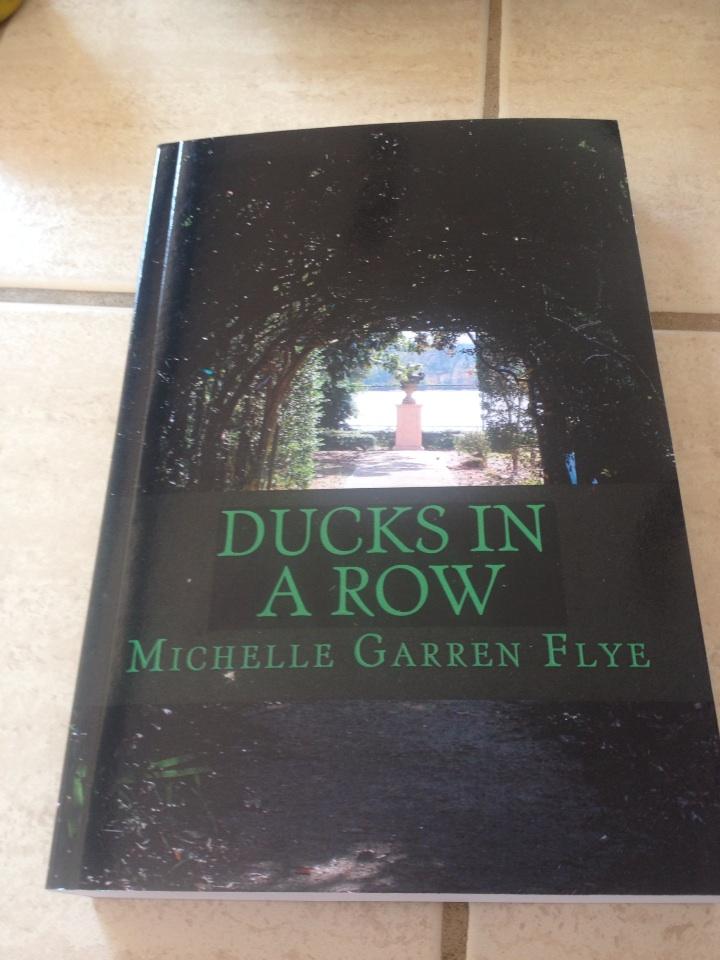
I recently published this picture on Twitter and Facebook:

Ducks book_large

I captioned it “A preview of things to come”. And yes, that’s my name on the front of an actual physical book. It’s just a proof copy for me to find all my errors (and there are a few), but when I give CreateSpace the word, it becomes real. It’ll really be for sale. You can order it from Amazon and it will arrive in a box. Huh.

Back in the days when self-publishing was called “vanity” publishing, it was, perhaps, the deadly sin of writing. I’ve dipped my toes into the swirling whirlpool of self-publishing by creating Kindle e-books from two of my manuscripts that I couldn’t find homes for elsewhere, but I never considered print-on-demand before. Recently, however, I was encouraged to jump in with both feet and see where the whirlpool takes me, and I decided to do it. I figured, hey, if nothing else, I’ll see my name on the front of my book (I think I see where the “vanity” comes in).

Yesterday the proof arrived. Proof of my vanity? Maybe. But it’s kind of neat to hold that book in my hands and know it’s something I made. From beginning to end, I created it. I took the picture that’s on the front cover. I edited it (and it takes courage to admit that, because it’s going to have some mistake). I built this book like my kids build spaceships with Legos. It’s not quite finished yet. I still have to make certain I don’t need to reformat anything else, and then I jump in, feet first, and find out what it’s really like being a self-published author.

“What’s the best piece of writing advice you’ve ever been given?”

In the course of Googling something else the other night, I ran across an article on a blog that intrigued me. The blogger devoted his entire time to tearing down a very successful author, whose name I shall not mention. In a nutshell, the blogger said she loved this particular author UNTIL she started following him on social media where said author made a number of missteps. Her main complaint, however, was that he never offered anything to the aspiring writers who clustered about him waiting for a morsel of genius to fall on them.

Instead, the author in question would fill his Twitter feed with his daily word counts, bits from his new books, or his favorite quotes from his old books. Why doesn’t the author just be himself? the blogger asked.

(Ahem. Possibly because he might not be his actual self. Lord knows, if I ever get to the point he’s at, I’m going to hire someone to handle social media for me. It’s part of the job of being a writer, but if you can afford to pay someone else to do it for you so you can keep doing what you really enjoy doing—writing—well, who can blame you…much?)

But I digress. This article got me thinking. Have I ever gotten any actually useful advice from a successful published author? I’ve seen several speak. Some tell stories about how they became successful. Sometimes you can glean some bit of something useful out of that, but for the most part, you’re left wondering, Why couldn’t that happen to me? Every now and then, though, somebody says something that sticks with you, that really helps.

Unfortunately, I honestly can’t remember who said the most useful writing tip I ever got from a published writer. I think it was a man, and I believe it was while I was in college. Other than that, I’m at a loss. At any rate, what he said was, “Tell you readers your secrets.”

That startled me. My secrets. He was talking about writing fiction. Novels. Not true stuff. Why would I tell my secrets? Real stuff. But I’ve found over the years that he was right. If you mix a little bit of reality into your fiction, it makes it live and breathe in a way that purely made up stuff could never do. And the great thing is, you don’t have to tell your reader what bits are true. You just write from the heart, mix in things that are true with things that you wish could be true or you fear ever coming true and what results is so much more than fiction.

Here’s a bit of writing advice from me, a published, if not yet successful, author. Don’t expect too much from your heroes. No matter how successful they are, they’re caught up in a balancing act, just like the rest of us. They may not have to make ends meet financially (well, the top 1% don’t, anyway), but they are trying to balance marketing and social media and family with what they really probably still want to do—writing. So don’t expect too much, but listen when you’re lucky enough to hear one speak. They might just give you that tidbit you’ve been waiting for.

What’s in a word? $#*% by any other name would smell as $#%%^, wouldn’t it?

This is how it happened.

I’m driving down the road the other night and a possum walks out in front of me. More than just about any other wildlife, possums freak me out. There’s something downright evil in the way they turn their long rat-like snouts to look at an oncoming car. Hit me. I dare you. Of course, most of them lose that particular battle, but they still startle me with their glares.

“Oh, (expletive deleted).” I slam on the brakes and swerve to avoid the creature.

My daughter, who has been playing quietly on her iPod in the backseat, says calmly in her little innocent voice, “What’s wrong, Mommy?”

“I almost hit a possum.” I wonder why I didn’t just go ahead and hit the thing. Why go out of my way to avoid something that I don’t like? Maybe it’s a deep-rooted fear that this one won’t die. It’ll grab hold of the undercarriage of my car and wait until I park and, unsuspecting, climb out, exposing my ankle to its sharp teeth and claws…

“What?” My daughter can’t place what kind of critter I’m talking about.

“You know, those things we see squished on the side of the road all the time.” (I’m probably not going to get mother-of-the-year for that definition, but it had been a long day, and last I heard I’m not in the running away.)

“Eww.” She exclaims as only a dramatic five-year-old can. But she knows what I’m talking about now.

I laugh and continue driving. It’s only later that I realize I used a curse word in front of her and she didn’t react to it. She’s heard it before…from me. Have I desensitized her already to the power of profanity? The thought is sobering.

As a writer, I’m interested in language and how certain words have more power than others. I’ve read countless articles about words and how their sounds affect people in different ways. (Here’s a really interesting article about the subject: Which Words Do You Love and Which Do You Hate?) Profanity is fascinating because so many people have such adverse reactions to the ugly words. Including me. I flinch when I hear certain words. They’re unpleasant. They have power over me.

When I was in high school, I knew a boy who always said “sugar” instead of “(expletive deleted)”. I thought it was cute. I thought he was cute. I knew what he meant, but by replacing the expletive with a much sweeter (pun intended) word, he accomplished something many of us have yet to figure out how to do. He used the power of language in a positive way.

Which leads me to my vow. I’m going to be a less profane person. Don’t get me wrong, I’m not horrible, but a “bad word” pops out every now and then. I’m not doing this because I think it’s wrong to curse, but because I want my kids to understand that words do have power over people. You can use them in a positive way (think speeches by great men like Martin Luther King Jr. and JFK) and influence people for good. But if you go throwing profanity and other negative words around, eventually the people around you become desensitized to your voice. What you say fades away and becomes less important, and when you do have something positive to say, you’ll be lucky if anybody hears you.

Giving away stuff today…

I get a great feeling out of giving stuff away. It’s a fun, sort of magnanimous, expansive feeling…kind of like I’m Robin Hood throwing gold to the poor.

Well, I’m not Robin Hood, and what I have to give isn’t stolen. I worked hard for them, but I do feel kind of like I have vast riches to give away because now I’ve got not one, but two books that I can decide to put on Amazon’s free kindle books list. So go get your copies of Weeds and Flowers and Ducks in a Row now. They’re free until Thursday. Enjoy!

Ducks in a Row Cover

Weeds and Flowers

Whoops, I did it again! Another foray into the world of self-publishing…

First of all, happy new year! In spite of all evidence and predictions to the contrary, we rang in 2013 last night. Which means we still have a chance to make this world a better place with what we do. I hope I’m accomplishing that by adding more books to it because I spent much of yesterday doing exactly that and my new book Ducks in a Row went live right about midnight last night. By the time anyone reads this, I’ll have the cover posted in the feature area to your left, but I’m very proud of this cover (designed by me), so I’ll post it here, too:

Ducks in a Row Cover

Okay, so that’s what I did yesterday, why did I do it? My former venture into the world of self-publishing may have won me critical acclaim, but it sure didn’t make me rich. And self-publishing a book, even the way I do it through Kindle Direct Program, is not an easy thing, and it is nerve-wracking. After all, my book was never professionally edited. My readers will have to do with my editing skills. Admittedly, I’m not totally untalented in that area, but even I will admit a professional editor adds a lot to my stories.

But I did it anyway. Why? My only answer…again…is that I love this story. I wanted it to be a book. And when I couldn’t find a publisher for it (it’s really more women’s fiction than romance and it leans toward the sweet instead of the spicy), I decided, what the hell? This story wants to be told. I want this story to be a book, but a book needs readers. I found some readers for Weeds and Flowers. A lot of them, actually. Maybe I can do the same for Ducks in a Row. At any rate, it’s worth a try.

Plus, since I designed the cover, I got to make my name pretty big. Nice, huh? I didn’t go Stephen King big for design reasons (I wanted everything linear on the cover because of the title), but it’s still pretty big… Still dreaming of the day when my name is bigger than the title itself.

Writing about Writing: My Year in Review

photo(18)

Today I looked at my bookshelves. You see, I have a new book to put on them. My brother-in-law gave me one of the best books ever written about writing. Stephen King’s On Writing. I’ve read excerpts but never the whole thing, and I’ve never owned my own copy, so I was thrilled to get it. Let me share one of my favorite excerpts from the book with you:

“You can approach the act of writing with nervousness, excitement, hopefulness, or even despair—the sense that you can never completely put on the page what’s in your mind and heart. … Come to it any way but lightly.” — Stephen King, On Writing

I LOVE that quote. It hits the heart of my writing experience every time I read it. When I sit down at my computer, I assess my own ambitions for my writing. Maybe I have an idea I can’t wait to tap into my computer. Maybe I’m ready to get lost in that other world. Maybe I’m ready to try, anyway. Or maybe I just want to update my blog or maybe I’m…not. King goes on to say:

“…it’s writing, damn it, not washing the car or putting on eyeliner. If you can take it seriously, we can do business. If you can’t or won’t, it’s time for you to close the book and do something else.”

On the days when I know I can’t take my writing seriously, I do find other things to do. If I know all I’m going to be doing is surfing the net or (worse) posting inane comments on Facebook all day, I go do something else useful. I’ve taken up cataloging my kids’ school library during these “off hours”, and I’ve found that I am far better off when I return to the writing I’m never very far away from.

So much for King. What really caught my attention when I looked at my bookshelves was another book about writing by Eudora Welty, also titled On Writing. I admit, I’ve never read this book. I bought it way back as a sentimental investment. I met Ms. Welty once, way back at some young authors’ conference or other. She was very old, and I’d never read anything she’d ever written, but she was what I knew I wanted to be: a published, respected writer. I was curious. Did she see writing as seriously as King does? I flipped through the pages and eventually came across this quote, which, to me, seems to indicate she does:

“We have the writer’s own vision of everything in the world when we place his novel in the center. Then so much is clear: how he sees life and death, how much he thinks people matter to each other and to themselves, how much he would like you to know what he finds beautiful or strange or awful or absurd, what he can do without, how well he has learned to see, hear, touch, smell—all as his sentences go by and in their time and sequence mount up. It grows clear how he imposes order and structure on his fictional world; and it is terribly clear, in the end, whether, when he calls for understanding, he gets any.” –Eudora Welty, On Writing

The last line of that rather lengthy quote gave me chills. Don’t we all want understanding at the end of the book? As I scanned the pages of Welty’s book on writing, I noticed she explores the relationship between reader and writer in a much clearer manner than I’ve ever seen before. In her many years of writing, Ms. Welty obviously established a very good understanding with her readers.

Over the course of the past year, I’ve grown a lot as a writer. I’ve discovered that just because I write books I want to write doesn’t mean that everybody will want to read them. I’ve discovered that even when they get published and read, my books won’t always establish that connection with the reader that I strive for. And yet, if I’m going to ask my readers to take me seriously as a writer, I have to, as King advises, never come to it lightly. I have to approach writing as a business. It’s a business you have to stick with, you have to work at, and the you must, at all costs, constantly strive to get better at it if you hope to connect with your readers.

This year, I’ve written a few blog posts I was sort of proud of about writing. Nothing compared to King or Welty, but I haven’t had their careers yet. Most of these are either about my impressions of what writing is like on this side of success or were responses to articles I’d read about writing or publishing. In case you missed my brilliance the first time around, I thought I’d include links to my top 10 favorite blog posts of 2012:

1. “Embrace your velvet-cloaked vampire: Go ahead and publish that book”

2. “How to make your setting into a character…and why you should”

3. “Self-published and proud of it: Stop squelching the new voices”

4. “Confessions of a Contemporary Romance Author”

5. “Music that isn’t mine or why there’s a gay woman in Where the Heart Lies: About Lulu”

6. “How a chronic beginner finishes writing a novel”

7. “Slacking Off: Writing is Hard Work!”

8. “Vanishing Literature or Just Disappearing Ink?”

9. “Playing with emotions: What do you want to feel when you read?”

10. “Immersing Myself in the Culture of My Creations”
Mayan Apocalypse? Maybe not, but it is the Winter Solstice: A few facts and an excerpt.

This will most likely be my last post…until after Christmas, that is, and I thought I’d make it a blatant sales pitch. Winter Solstice was my second book published, but the first full-length romance I ever wrote. I’m very proud of it, and I’d love to share a little excerpt with you guys. First, though: A few facts about Winter Solstice 2012:

1. It’s the shortest day of the year in my half of the world. Tomorrow, December 21, 2012, daylight will last only about nine and a half hours in the mid-Atlantic region of the United States.
2. It’s the official start of winter in the Northern Hemisphere.
3. The actual time of the winter solstice is 6:12 a.m. on December 21 for me. This is, ironically, 11:12 a.m. GMT, meaning the winter solstice actually occurs at 11:12 a.m. 12/21/12 this year, if you happen to be in Great Britain. Ahem, like Stonehenge. Cool, huh?
4. Winter Solstice contains the only phone sex scene I’ve ever written… Oh wait, that’s not about the winter solstice, but it is interesting, isn’t it? 😉

Continuing her tour of the artwork, she paused before a large painting, showing two deer in a wintry landscape before a rising full moon. It occupied the wall opposite the Redlin painting. In sharp contrast to the warm oranges and reds and nostalgia of Redlin, however, everything in this painting, from the stark snowy landscape and sharp blue-black shadows to the bare trees and the ribs showing through the deer’s hides, spoke of starvation. Winter Solstice was printed on a brass plate on the frame. Becky stared at it for several long minutes, letting its barrenness creep into her soul, its iciness encompass her entire being.

“You like it?” he asked from behind her.

“Like isn’t the right word.” She shook off the creeping feeling of cold and loneliness with difficulty. “It’s powerful, though. My favorite day too.” She let him guide her through the swinging door into the large, stone-floored kitchen. Despite the shiny, stainless steel appliances and granite countertops, the kitchen had a homey air due to the little breakfast alcove with a rough-hewn wooden table that was now set for dinner under a wrought-iron chandelier. Susie pushed her way through the swinging door and padded over the wide planks of the hardwood floor to the firewarmed stone hearth of a large fireplace near the table. She shifted around on the stones, finally coming to rest with her huge head on her paws.

John opened two beers and set them on the table, taking Becky’s wineglass from her in a smooth movement as he motioned for her to sit. He set a plate of rockfish, steaming baked potato and salad in front of her. “Why is the winter solstice your favorite day? I would have had you
pegged for a spring person.”

He sat across from Becky, focusing all his attention on her. It made her a little self-conscious, but as he turned away to heap butter and sour cream on his potato, she found a reply. “It’s the shortest day of the year.”

His eyebrows shot up and he glanced at her. “Doesn’t explain why an optimist like you would like it. Seems like the perfect day for somebody like me.”

Starting to feel even more ill at ease, as if this were something too personal to tell him, she opened her mouth and closed it again. When he raised his eyebrows, she realized he wouldn’t let her not answer. “Well, if it’s the shortest day of the year, it means the rest of the days afterward
are getting longer, right?”

A slow smile spread across his face and he nodded, as if her answer fit in perfectly with his perception of her. “I get it.”

She wondered why he felt he knew her so well when they’d met such a short time ago. “What exactly do you get?” She took a bite of baked potato and tried to remain calm.

“Obviously, to you, it doesn’t matter where you’ve been or where you are so much as where you’re going.” He chewed thoughtfully for a moment. “Whereas I find it difficult to look past where I am at the present.”

Want to BUY IT NOW? The link is to the Lyrical Press store, where you’ll also find links to many other great e-book retailers.

Change for the Children: Making Kindness a Habit

Over the past few days, I’ve struggled a lot not to be political in the wake of the Newtown tragedy. It’s been tough, because, as my husband tells me, I’m very passionate about certain things, and, in my eyes at least, there’s no room for compromise. So keeping my mouth shut can be a challenge for me.

But by keeping my mouth shut, I’ve heard some surprising stuff. I’ve learned a lot about the lack of care for the mentally ill. I heard our president say that we as a society needed to change. I heard a resounding silence from gun supporters. And most surprising of all, perhaps, I’ve heard many, many people saying we all need to be kinder to each other.

I could ask when we stopped being kind to each other, but I’ve found it’s much more effective to start at home base. When did I stop being kind? I was a very kind child, I think. I never wanted to hurt anyone’s feelings. When did that stop? When did I become an aggressive driver who’s willing to honk at other motorists for the slightest infringement, the irritable mother, the uncaring neighbor, the shopper who’s in too much of a rush to let someone cut in line?

Okay, so I’m not horrible. I’m not always irritable and pushy, but I’m much more likely to be that way than I was early on in life. The only thing I can figure is that as I’ve gotten older, unkindness has become a habit with me. So how do I cure this habit?

I think journalist Ann Curry, of all people, has given me the answer. If you are on Twitter, check out her twitter feed. She started out calling for everyone to commit themselves to 20 acts of kindness (#20acts) to honor the twenty first graders killed at Sandy Hook. Some of her followers suggested they expand this to include the adults killed trying to save the children (#26acts). It’s a wonderful idea, and for more reasons than I think Ms. Curry considered.

I believe you can become addicted to kindness. Think of the good feeling you get when you do something kind. Consider the impact of getting addicted to that feeling. How long does it take to form a habit? If you commit to performing 26, or even 20, acts of kindness, might it be possible that you would want to keep going? I’m hoping so. Judging by the number of positive responses Ms. Curry has garnered, I think she may have started a movement with some real power behind it, and if all those people form a habit for kindness because of her, she will really have accomplished something lasting.

Will a kindness habit cure the world’s problems? Probably not. But perhaps if enough people are more considerate and kinder because of Sandy Hook, more problems could be solved. Maybe we could learn to compromise and care a little more, and maybe fewer people will want the guns that are made to kill without mercy.

So far I’ve accomplished a rather unimpressive three acts of kindness. They weren’t things I wasn’t planning on doing anyway, but I tried to go a little beyond. I have plans for two more, and I’m watching for opportunities to act kindly on impulse. I think those acts might go the furthest toward accomplishing a real change in our society.