Unknown's avatar

About Michelle Garren-Flye

I am an author of romance, poetry, children's books and graphic novels. I also own a bookstore. My love of the written word runs deep.

What do I write about?

“So, what do you write about?”

I usually dread being asked that question, although it’s far from unreasonable. I dreaded being asked about my writing so much that for several years after I started writing seriously, I avoided mentioning my writing at all. I did tell one friend early on, who patted me on the shoulder and said encouragingly that it was good that I had such a neat “hobby”.

Incredibly, this discouraged me so much I immediately clammed up about my writing.

However, when I got serious about publishing a novel, it occurred to me that this particular method wasn’t going to work wonders for sales. I had to let the cat out of the bag, and not just to my close friends. I had to let the world in on the fact that I write. And if I was going to do that I needed to come up with a sensible answer to the writer’s most dreaded question: What do you write about?

Problem is, all my answers sound very trite. “Love.” “Romance.” “The psychological intricacies of a loving sexual relationship between a man and a woman.” Okay, that last one isn’t trite, it’s just silly and I could never say it with a straight face.

In search of an answer for myself, I asked some women writers I am lucky enough to call friends for their answers. Here they are, in the order in which they were received:

Lisa McMann, author of the best-selling trilogy Wake, Fade and Gone: “I write about the underdog.” Want to read a story by Lisa? Try this one: The Day of the Shoes.

Didi Wood: “This question always makes me think of a scene in Clint Eastwood’s Unforgiven, where retired gunslinger Will Munny asks biographer W.W. Beauchamp: ‘A writer? What do you write … letters an’ such?’

“I write fiction – stories and novels. My writing tends toward the literary, in that it’s focused more on character than plot. Longing and a desire for connection seem to be prevalent themes (I know that only because a friend pointed it out – I’m horrible with the big-picture, summary-type stuff). I write what moves and entertains and haunts me, with the hope that it will have the same effect on readers. The simple answer, I suppose, is that I write what I want to read.

“(I should add that it took me two hours to compose that succinct little answer – that will give you a sense of how tough the question is for me. I removed the bits where I say what I do NOT write – who wants to be defined by negation? – and the parts where I bitch about my other favorite questions, including, “What’s it about?” and “Have I seen anything you’ve written?” and “Do you get paid?”)”

Want more from Didi? (Trust me, you do!) Check out this story: Home Again.

(Note: My next answer came from an excellent writer I have known for years, Avital Gad-Cykman. However, I hesitated to print what she answered because I wasn’t sure if she was answering my request for an answer or the question itself. She assured me this is her answer when presented with the opportunity.)

Avital Gad-Cykman: “I’m sorry, but I’m really allergic to this question…” You can find lots of Avital’s elegant fiction online for free by Googling her, but here’s one to get you started: Crystal and Gold.

Debbie Ann Ice: “Let’s see, I usually say, ‘fiction’. Then there is this eerie silence like they are trying to remember what that is. Then they say, “what kind of fiction?” My response is “mostly short stories, but I like novels too.” Usually I change the subject before they start the “Are you in the New Yorker? Do you have a novel published?” But people talk fast here and changing the subject is hard. I sometimes tell them where to go to find my stories. And if I send them the url below, they tend to stop calling me.” Curious? Check it out: Dead Crows.

Marcia Lynx Qualey, who lives in Cairo, Egypt, where she teaches a fiction workshop and maintains the literary blog Arabic Literature (in English): “When answering in Arabic, I sometimes say ‘qusas,’ (stories), although this implies that I write for children. Sometimes I say ‘adab’ (literature), but this seems too snotty. Usually, I just say that I write for a ‘journal fi Amreeka.’

“In English, I make out that I’m just a book critic, and say that I review for magazines (which is true, but obviously not the whole of my writerly identity). It’s much more comfortable than explaining that I see myself as a–good grief!–artist.”

You can find one of Marcia’s stories here: Creation.

Alicia Gifford: “When I’m asked about my writing, more specifically, ‘What do you write?’ I say I write short fiction. Because I do! The next question that invariably comes is, ‘Have you ever been published?’ ‘Yes!’ I say. ‘Google me.’ Sometimes, if the look on my querier’s face is still blank, I might add that I write short stories like what they feature in The New Yorker. ‘Have you been in The New Yorker?’ ‘No,’ I say, ‘not YET.'” Find out why I think Alicia will have a story in The New Yorker sooner rather than later: Desilu, Three Cameras.

Bailey Hunter, founding member of The Horror Library and creator of Dark Recesses Press: “When I tell folks I write, of course the first question is ‘What do you write?’ I desperately want to say WORDS, but I know this won’t do. It’s like when my kids ask me what’s for supper and I say FOOD. Apparently that’s not enough info.

“So instead I say I like to write ‘literary horror’. That is usually good for a few blank stares followed by ‘Oh. You mean like those Jason movies?’ Uhhh…Yeah. No, not like those. I like to write scary stories that cause you to think, to feel. Cool creep instead of instant gag reflex.

“Next question is ‘Have you published anything I would have seen?’ Answer: Probably not since you’ve just compared all horror to Friday the 13th.”

Bailey’s stories have appeared online and in print. (Check out The Horror Library Volume 1, which also features a story by yours truly.) For a very brief look at Bailey’s fiction that’ll leave you wanting more, try: Price of Immorality.

Ellen Meister, author of Secret Confessions of the Applewood PTA and The Smart One: “When people ask, ‘What do you write?’ I usually answer, ‘Novels.’ This is invariably followed by the dreaded, “What genre?”

“I wish I had an easy answer, like ‘mystery’ or ‘thriller’ or ‘romance.’ But each of my books can be categorized in a different way. My first, SECRET CONFESSIONS OF THE APPLEWOOD PTA, can easily be called ‘mom lit.’ I’m fine with that, but my second book, THE SMART ONE, has a childless protagonist. That one is more accurately called a ‘sister story.’

“Both of these books employ a lot of humor, but I can’t call myself a writer of comic novels since my next book in the pipeline, THE OTHER LIFE, is pretty serious, and even has a paranormal element. I suppose they could all be called ‘women’s fiction,’ and I’m fine with that, but really despise the dismissive reaction that usually gets.

“What to do? I think from now on I’ll tell people I write mainstream fiction, give them a free bookmark, and let them figure out the rest on their own.”

If you’d like to get a free taste of Ellen’s work (I highly recommend it), check out this story: Finding Cooper. If you’re like me, however, and just a short story isn’t enough, you can find a synopsis of her upcoming novel here: The Other Life.

Well, at least I know my friends and colleagues have the same problems answering questions about their writing that I do. And talking to them has helped me come up with an answer. So ask me again.

“What do you write about?”

“Thank you for asking. In a fiction workshop a long time ago, I was told to write about what I know. I know about being a woman, so I write about women and the relationships they have with the world around them, often romantic, but sometimes familial, like between mother and child or sisters and brothers.”

Whatcha think about that answer?

Making a banner ad

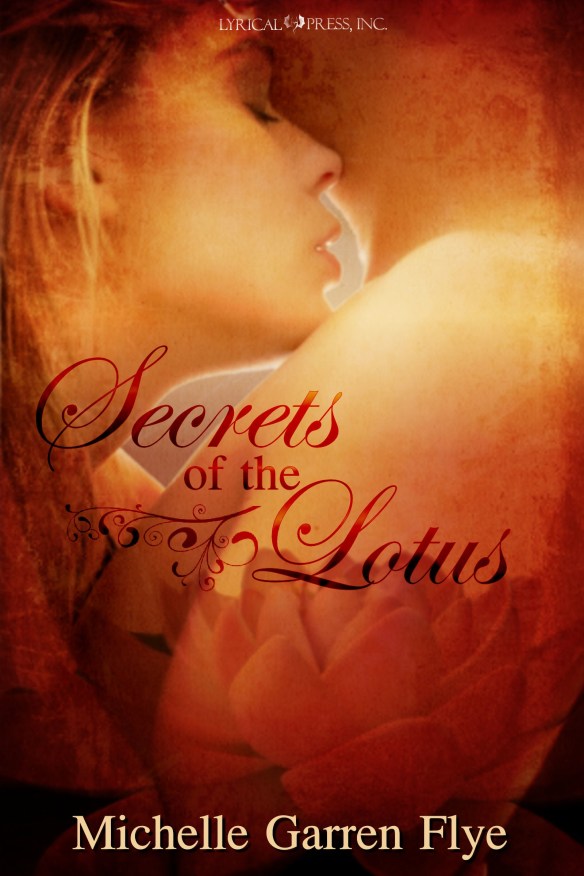
Now that I have a release date for Secrets of the Lotus, I’m working on some promotional stuff. Here’s a banner ad I made today:

It features the lovely cover art created by the talented Renee Rocco. Anybody have any feedback on the ad or want to feature it on your own blog, let me know. Now I’m off to proofread!

Just breathing

Today I’m practicing breathing. Some days I’m not aware of a single breath I’ve taken during the day. I’m always hurrying from one thing to another. With three kids and writing and editing, I don’t take time to breathe at all.

Good thing it’s automatic.

Yesterday I found out my book will be released in electronic format on July 5, 2010. All right. I knew it was coming, but to have an actual date, just like that. A momentous occasion. My breath stopped for a second.

My favorite t-shirt says “Breathe” on it. A friend asked what it meant. I told her it was a reminder. For me or whoever reads it. Keep on breathing, keep on plugging away. Eventually you get there, right?

It took me eight years to get to this point, and I’m still not at my final destination with my writing. But if I keep breathing, I’ll make it.

Secrets of the Lotus

Springtime inspiration

Dogwood

At the risk of repeating myself, I love this time of year. So many of my stories have been born at this time of year. One in particular I remember writing when spring sprang. Beauty in Art. It’s a lighthearted piece inspired by my mother-in-law’s garden in springtime. I’m much too lazy to plant and tend a garden of my own, but I do enjoy a lovely, colorful mix of flowers and plants in spring.

Fortunately for me, other people around me aren’t as lazy and I can flower gaze to my heart’s content in the yards of my neighbors and friends as I drive by or visit. Today while admiring a friend’s daffodils, I started thinking about what inspires me. Of course, the words have to be there and I have to have the drive to put them on paper (or computer screen), but it helps to have a spark to get me going, and if I know where to find that spark, all the better for me. I thought I’d put down a few for posterity since I’m still playing the waiting game with my novel.

Things that inspire me in springtime:
1. Daffodils. Preferably a field of them. I love the yellow and green. I particularly remember one daffodil that sprang up, seemingly spontaneously, in the middle of the yard when I was a kid. I’ve admired them ever since.
2. Dogwoods. White ones, especially. They look like clouds when they are in bloom.
3. The beach. Sun sparkling on waves, warm breezes after a cold winter, little long-legged birds pecking for clams in the sand.
4. Birdsong. Just not at five o’clock in the morning, please.
5. Frogs. I love the little ones that cling to the window with sucker feet. I also love the bullfrogs that will sing deep-throated melodies in a few weeks as they search for mates.
6. Green! Luscious green after all the brown and tan for the last six months. So much softer on the eyes.
7. Robins. They really are harbingers of spring. After being absent since December, I saw my first one again in February, but they didn’t return in flocks until March.
8. Rain. Spring rain is so much more inspirational than the hard, cold rain of winter.
9. Spanish moss in an old tree. In fact, Spanish moss in any tree, and really, I shouldn’t limit this one to spring. It’s there, year-round, surviving, living, thriving where you wouldn’t think anything would.
10. Children’s laughter. My own especially. Pure joy at being out in the warm weather after being stuck inside for so many months.

Redux

Okay, a few weeks ago I wrote about The Last Song by Nicholas Sparks. I read the book. Tonight I saw the movie, and I feel like I can tell you what Paul Harvey always called “the rest of the story.”

Movies and books are two different entities. I know this, although I’ve never written a screenplay. When I was a kid and would see a movie based on a book I’d read, I’d sometimes take the book with me to the movie theater, intending to follow along. Sometimes it would work. Often it wouldn’t. I didn’t realize at that time the difference between a novel and a novelization. So I didn’t understand why the book Benji was exactly like the movie while the book Little Women was so different.

I have said from the beginning that, as a writer, The Last Song intrigued me because of the way it was written. The screenplay was written first, therefore, how could the book be anything but a novelization of the movie?

How indeed. I’m still puzzled. And impressed. The movie stands on its own. While both book and movie use the same characters and tell the same story, the book goes much deeper into the motivation of the characters, telling a story of love, family and devotion. The movie, on the other hand, uses some amazing scenery and draws on the talents of the actors to depict the story with just as much intensity of emotion.

I foresee some awards in this movie’s future. Miley Cyrus has definitely broken away from Hannah Montana. In my opinion (very humble though it is), Greg Kinnear did some of his best acting yet. But the Oscar (again, just my opinion), should go to Bobby Coleman, who played Jonah, the little brother of Cyrus’s Ronnie. Jonah was one of the constants for me in both book and movie — my favorite character in both.

Other highlights of the movie include a pretty cool fire juggling scene (though this was not as integral a part of the movie as it was the book — to my disappointment); a hilarious portrayal by Nick Searcy of “Tom Blakelee”, whose slightly clueless character I enjoyed much more in the movie than the more straightforward good dad in the book; and Carly Chaikin as “Blaze”. I have a feeling she’s an actor worth following, though, again, her character did not play as integral a part as she did in the book. Oh, and let’s not forget Liam Hemsworth, who was the epitome of “Will Blakelee”.

Overall, another winner for Sparks. The book debuted as a number one bestseller, and I look forward to hearing that The Last Song, which follows close on the heels of Sparks’ number one movie Dear John, has led the box office for this weekend. Go see it. It’s good, and it’ll make you cry.

Clean those tear ducts out.

Save the Bees

My Haagen Dazs Bee

I’m taking a break from boring you guys about my novel (which is still with the line editor, anyway) to tell you about an issue that terrifies me, not only because it could be horrific for all of us, but because it’s getting so little attention in the mainstream media.

Seems like, if something was happening that would threaten one-third of our food supply, it might be a mainstream media issue, doesn’t it? Seems like, if this issue had been steadily growing worse over a four year period, it might get a little attention, right? And maybe, just maybe, if that problem suddenly got three times worse, it might make the evening news.

Yet nobody cares about the honeybees. They’re quietly dying, taking with them the art form of pollination, and nobody’s paying any attention. According to studies, a variety of pesticides have been found in the pollen and wax of beehives in 23 states. Fortunately, that pesticide doesn’t affect the pollen and honey people consume, right?

Wrong. If these pesticides are getting into the bees’ food chain and driving them away from hives causing colony collapse disorder, guess what? Bees die, plants die. We could lose one-third of our food supply and that’s not even taking into account the loss of food for other animals that we use for food. Hey, maybe there’d be no more hamburgers or chicken nuggets, either.

Might solve the obesity crisis, at least.

Some interesting reading on this subject:
The Bee Project
Bad Winter Deepens Worsening Bee Crisis
Save the Bees Petition
Help Save the Bees
Help the Honey Bees (from Haagen Dazs, pretty cool site, you can even build your own bee, which I finally figured out how to post, see above.)

Your Mandala

Things are really speeding up with my novel, at least that’s how it seems at the moment. I’ve written my dedication and acknowledgments, which was quite simply the funnest thank you note I’ve ever written. Now the manuscript is with a line editor, and I’m quaking because I don’t know quite what to expect. “Line editor” sounds sort of frightening.

So, with my latest literary endeavor still pending, I’ve been looking back at some of my old ones. You can see a few under “My Stories” to the right. These are all online and free, so have a look if you’re interested. Some are better than others, and a few might shock you. 🙂 Most are really short, either micro- or flash fiction. Somebody once described flash fiction to me as “being afraid of words” (sorry, I can’t remember which one of my friends it was, but if you want to step forward and claim it, I’ll be happy to attribute that quote). I don’t actually agree. Flash fiction was an essential step in my development as a writer. Flash fiction writers learn to write concisely, digging out the heart of the story.

One of my favorite stories actually qualifies as a short story. I’ve seriously considered trying to convert it to a screenplay, but that’s a whole new kind of writing I have yet to experiment much with. The story is “Your Mandala”. I loved this story from the moment I wrote it because the characters spoke through me rather than me speaking for them. Plus, it was the first story since third grade that actually won a contest. Check it out and let me know what you think.

Last, but not least, I finished a book by a friend. Gone is the last book in Lisa McMann’s bestselling Wake trilogy. Though technically classified as “Young Adult”, I can tell you there’s plenty there for adults. My favorite of the three was the second, Fade, but Gone wound up the trilogy in the best possible way. Loved every word and read all of them!

Shakespeare revisited

If you’ve already bought your copy of Shakespeare’s Complete Works, get ready to take it to the used bookstore. Surprise. Scholars have discovered another one. Check it out here: Lost Shakespeare.

What gets me is not so much that Shakespeare’s got another contender for the bestseller list nearly four centuries after his death, but that there are people who actually care. Shakespeare did what every serious writer wants to do: he’s lived long past his death through his words. I mean, how cool is that? Even I, chicklit and romance writer that I am, would love to think that someday, even twenty years after my death, people might still be reading things I wrote. Four hundred years? Well, that would be cool, too.

William Shakespeare might not have been trying, either. Although I’m not an expert, I think Shakespeare was a working writer. Respected, yes. Acclaimed as a genius, no. At least not during his lifetime. Quite possibly, Shakespeare was just a man with talent who was trying to earn an honest dollar doing something he loved. And yet his work lives. I know that for a fact. My high school teacher made me read some of it.

Myself as a reader

I just finished The Last Song, and the most important thing I can say is, I read every word.

To understand that statement, you have to know what kind of reader I am. When I was a kid, I read everything word for word. I even read the typos because it felt dishonest not to. I never liked to be without a book, preferably a novel, preferably from the mystery or sci-fi genres. I didn’t just devour these books. I savored every word and phrase. It might take me a couple of months to finish one book, but during those months I was happy, lost in that other world. My nose, literally, almost always in a book.

When did it change? I wail to the sky. When did I lose that ability to lose myself in a book? Was it motherhood or was it getting serious about writing my own books? Either one might have caused it, but I imagine it was a combination. After all, between those two, my opportunities for reading are confined to a few minutes before bed (unless I’m working at that time) and in the mornings when I’m brushing my teeth and combing my hair.

I still read when I can, but I read differently now. I usually scan the first chapter or two, then I (gasp) skip to the end. If it looks like a good ending and I’m intrigued by how the writer got there, I go back and start reading. Sometimes I read for a while, scan when the book loses my interest and go back to reading. Sometimes I skip forward and backward. Sometimes I completely lose track of where I was. Then I have to figure out whether the story is worth continuing. After all, I already know how it ended.

How did I read The Last Song? Obviously, as I’ve said before, I was intrigued by how the book came into being. I started out and read the first chapter. Then, realizing I really wanted to know what happened to the main character, I skipped ahead and scanned the last chapter. Yes, I thought, I want to know how they get here. So, I started reading. For the most part, I managed to keep myself on track, only getting impatient a few times and skipping ahead a few pages to find out if what I hoped would happen actually did. And when I finally closed the covers and emerged from that world, I added The Last Song to a pile of books that is a dying breed: Books I have read word for word.

What other books have I read word for word? The Harry Potter series (although I did read the last chapter of book 7 first), Watership Down, Little Women, Secret Confessions of the Applewood PTA, Pet Semetary, Wake, and (quite) a few others.

What’s the next book I’m planning to read word for word? Mine. Secrets of the Lotus by Michelle Garren Flye. I’m about halfway through it now in an attempt to make sure I don’t miss any mistakes.

If I weren’t the author, would I read it?

Interesting question.

Just another update

Sorry it’s been so long. I’ve been at Disney World, which is at one and the same time the greatest and worst place on earth! There’s so much I loved and so much I could have done without… Maybe I’ll go into that at another time. For now:

1. Sent off my latest round of edits/rewrites to my editor. Have I mentioned how talented she is? She’s pulled so much more out of my manuscript than I ever thought was there.

2. I’m reading right now. I don’t read fiction when I’m writing for fear the other author’s style will sneak into mine. At the moment I’m reading Nicholas Sparks’ The Last Song. More about this later. For now I’ll just say that I think my career as a writer sometimes interferes with my enjoyment as a reader. For instance, The Last Song fascinates me because of the way it came into being. The whole time I’m reading it, I’m wondering about how Mr. Sparks wrote the movie script before he wrote the book. Okay, how does that work? Will the parts I love in the book be in the movie? How will they translate to a visual format? I guess I’ll have to see the movie to find out, and I can’t wait!

3. I’ve finally got a handle on the characters in my latest effort, and now I’m working on the structure. Did I mention that I wrote 30,000 words before I had a real idea about the structure? Not a good idea.

4. Finally, I just want to send out a salute to all the writers (and there are many of them out there) who can make me stop in the middle of reading their work and say, “How the HELL did they write that?” I could name a few here, many of whom I consider friends — and some of whom you’ve never heard of and won’t find in a Google search — but I won’t because I’d no doubt leave somebody out. But you know who you are.

5. Now it’s time to put on my editor’s hat. I’m working on Dark Recesses stuff for the rest of the weekend, catching up and getting up to speed, to mix metaphors in (I hope) an effective way. Look for a new .pdf from us soon!