
Hidden room dream: Getting older, getting busy again, getting to know who I am

Yesterday, I had to admit—at long last—that I just can’t see my computer screen as well when I wear contacts. So I pulled out an old pair of reading glasses I once used for a Halloween costume. In spite of myself, I was hoping they wouldn’t work.

They did.

Here’s me seeing my computer screen clearly without squinting. So I’m getting older. Better than the alternative, I always say.

Today I find myself in a quandary in spite of my new ability to see clearly. I want to write again, but I’m unsure what to write. I’ve been in stasis mode for a few weeks, though, you see, so it’s harder than I anticipated jumping back into the pool of work. I usually get anxious if I’m not writing something, but I’m surprisingly calm about it this time. And I think I can attribute that to the hidden room dreams.

If you’ve never had hidden room dreams, let me tell you, they’re a trip. For me, I was always wandering through our extraordinarily cluttered house (it was worse in the dream than in reality) only to find a door I opened to reveal rooms I never knew my house possessed. These rooms were always furnished, as though ready for use, but in my dreams I always realized it would take some work to make them functional.

I had this dream often enough so I looked it up online. Hidden room dreams, I found, were an indication that there’s some talent or ability hidden in our psyche that we aren’t making use of. Interesting, considering I started having these dreams right after my first foray into community theater. If ever there was someone you wouldn’t have thought suitable for the stage, it is probably me. I have a definite fear of public speaking. I remember nearly fainting in high school when I had to give a three-minute speech. Just a few years ago, I attempted to conduct a few writing workshops, and, well, they weren’t bad, but they weren’t what I would call good, either.

But theater is different. You’re somebody else, from the makeup (I never wear eyeliner except onstage) to the clothing (ah, those sumptuous nineteenth century dresses I wore!) to the words (speeches I would never have made on my own). Okay, I’ve only had bit parts so far, but in one play I did have more than a dozen lines!

And now, here I am, having just finished directing (and writing, at least a little bit) my daughter’s talent show, taking singing lessons in preparation for auditioning for another musical—and no longer haunted by hidden room dreams. Is it possible my hidden rooms were theater-related all along? Maybe the “clutter” in my dreams was my desire to tell stories, that I’ve always restricted to the arena of writing. If I move it into theater as well, I’ll have another outlet and more room in both parts of my psyche.

But never fear, I’m not giving up on my writing, either. Jessica Entirely, the first of my middle grade Jessica mysteries, will be ready for publication in June. I’m now working on the polishing of Timeless, the final book of my Synchronicity series. And Magic at Sea, book 7 of Sleight of Hand, should be ready for an October 31 release! Plus, I’ve already started planning Jessica Naturally, which I’m hoping to have out by Christmas.

So even as I explore these hidden rooms and try to dust them off so they’ll be functional, I’m adding to the clutter on the other side of my psyche. Can’t be helped, though. I guess I’ll just have to add more shelves over there!

Poem: In Her Prime

I have a particular affinity for daffodils. I’ve taken dozens of pictures of them this spring alone. They’re almost done here, but I found this lovely this morning, and it seemed like a special gift to me. So I wrote a poem about her.

In Her Prime

By Michelle Garren Flye

A little wrinkled,

She holds up her bobbing head.

Not done yet, she says.

Author’s Note: Happy shared birthday, RBG. Sometimes wrinkles make you stronger.

Hallelujahs and the creative process (with a poem)

By this point everyone probably thinks they know Leonard Cohen’s song “Hallelujah”. It’s been in movies and television. Even Kate McKinnon had a go at it on Saturday Night Live. So even if, like many, you’re confused about the meaning of the song, you probably think you have heard it from beginning to end.

Possibly think again.

For my own reasons I’ve been doing some research on this song. It was supposed to be a simple Google search, but I found a rabbit hole and plunged right in. I found that there are more than 300 recorded versions. Not surprising considering Cohen wrote more than 80 draft verses for the song. Maybe that’s why he also recorded two versions himself.

According to legend, he spent one writing session in a motel room writing verse after verse while sitting on the floor in his underwear.

That’s quite a creative process.

In spite of all he went through to create his masterpiece, Cohen never expressed disappointment that other versions came to exist when others recorded his song. (Recording artists have rearranged verses, changed words and omitted lines.) In fact, he said himself that he believed that many hallelujahs exist. To me, this explains why he let the act of creating this work of art to consume him so. And I think he’s right. If we let ourselves, we find our own hallelujah.

By the way, I listened to many, many versions of this song while I wrote this. My favorite? Cohen’s live performance in London in 2009.

Many Hallelujahs (for LC)

By Michelle Garren Flye

A mother approaches a borderline.

Safety awaits her on the other side.

Baby in her arms, clutched against her breast—

She crosses the line and whispers, “Hallelujah.”

A black man sits alone in his car.

Flashing blue lights his rear view mirror.

He knows his fate is not his own,

So when he is told to go, he says, “Hallelujah.”

A woman awaits her weekly call

From desert sands so far away.

This world has so many dangers for her heart—

The phone rings and she cries, “Hallelujah.”

The activist lays it on the line every day,

To make a difference, he argues and persuades.

He won’t stop until he’s made it right.

Then someone listens at last and he shouts, “Hallelujah!”

The writer ponders the meaning of one word

And writes and writes, thinks it will never be his.

He bangs his head—and then it’s in his grasp.

His tired hand shakes as he declares, “Hallelujah.”

Confession time: Imagine, my deepest secret

So, here’s my confession. The deepest secret I’ve been keeping for the last two months.
I’m taking singing lessons.

What? You’re not shocked? You would be if you knew me. I’ve always said I can’t carry a tune to save my life. I’ve even claimed to be tone deaf.

Long story short, my very brave and lovely voice teacher gave me first choice of songs to learn, and I chose Imagine by John Lennon. At this point, I’ve sung it so many times, I know it by heart—and by that, I mean more than just that I know every word.

It’s like those words are, literally, inscribed on my heart.

I’ve always loved the song, of course. But until I had to do the work of matching the words to the music and singing them more or less in tune, I didn’t really think about their meanings.

Imagine there’s no heaven…no hell below us…living for today…

What might the world be like if we were all driven just by the desire to live our best lives right here? On earth, right now. This is the moment we have. This is the only moment we have.

…no countries…no religion too…living life in peace…

Can you imagine that? Can you imagine living your life for your family and the people you love without imagined boundaries to separate us? No race, no patriotism, no gods to get in the way.

Am I dreamer? I bet there are more with the same dream. Heck, it’s what Star Trek is based on.

…no possessions…

That’s a big one, isn’t it? That’s why the next line is, “I wonder if you can.” It’s a big ask. A revolutionary thought in a capitalistic society that puts different values on skills. But what if everyone’s skills were regarded with the same value? If we truly reached that point of nirvana where the garbage collector’s service is of the same value as the teacher’s and the doctor’s?

no need for greed or hunger…a brotherhood of man…

And forget lawyers and criminals because:

…imagine all the people sharing all the world…

Do you see? What Lennon dreamed was a world of pure freedom unlike anything any of us have ever experienced. I’ve dreamed of that, too. But I’ve never fought for it. Too caught up in what the world actually is to be able to see what it could be, I guess.

It may be too late to have that world, but we can dream it. We can imagine it if we try really hard—and if we can imagine it, we can work toward it.

Imagine that.

March is Women’s History Month

March is Women’s History Month. How many of you knew that? I’m thinking fewer than should. We all know Black History Month is February, and many of us know April is Poetry Month, but for some reason Women’s History Month isn’t well known.

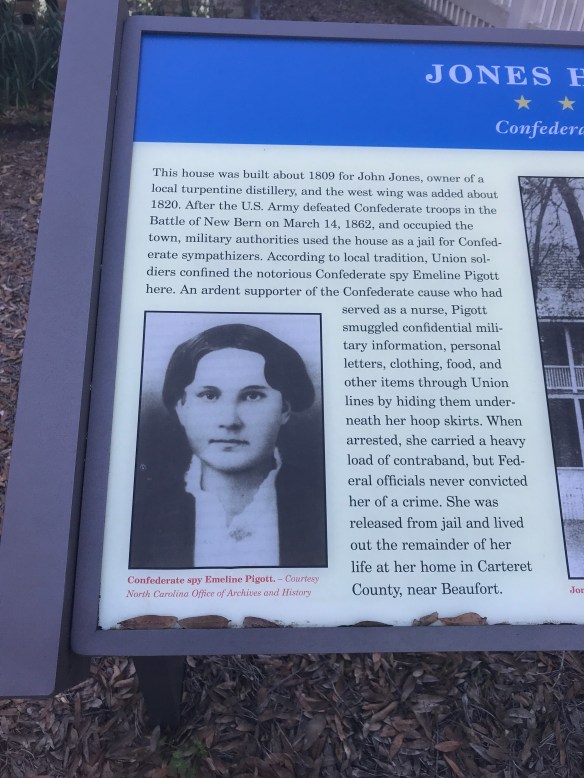
I’m thinking it may be because so much of women’s history isn’t known. It’s been suppressed in favor of men’s account of women’s history. I found it interesting, for instance, when I happened upon this little tidbit of women’s history on a trek around my hometown:

I did a little research on Emeline. Her name is alternately spelled Emmeline and Piggott or Piggot or Pigot or Pigott—even once in a newspaper clipping about her arrest “Eveline”. There are many stories about her, including that she “entertained” Union soldiers while her brother-in-law carried contraband to Confederate troops, that she ate a letter when she was arrested instead of turning it over to Union soldiers, and that while she was jailed an attempted assassination by chloroform failed because she broke a window to breathe through until help arrived.

It’s interesting to me because in some places, these stories about Emeline are referred to as legends and in other places are reported as facts. Even here on the sign, it says “According to local tradition”. That’s almost equivalent to “Once upon a time”. But Emeline was not a fairytale. She was a real woman, and, regardless of politics, she suffered for a cause she believed in.

It got me thinking about what women went through to get the vote. Until a few years ago I’d believed they marched peacefully, well-dressed and carrying banners because that’s what the school history books depicted. The reality is less appetizing, though. A few years ago I read about “the Night of Terror” when suffragists were beaten and tortured. A little shocked, I did more research.

Suffragists were badasses. Seriously. They didn’t just stand around with polite placards saying please let us vote until reasonable white men decided to give them the nineteenth amendment. There was property damage, rude signs and screaming at the president and Congress. Incarcerated women went on hunger strikes and were force fed with rubber tubes.

No doubt they were told at some point not to be so emotional.

I wonder if today’s men would dare to tell them to “smile more”.

My point is, you won’t learn about most of women’s history in schoolbooks. “Women held protests on the White House lawn and were given the right to vote in 1920” is about all you’ll get there. What women need to remember is that for decades women fought for the right to vote. They fought with much more than just orderly parades and when saying please failed, they didn’t hesitate to declare all out war.

Should we allow that history to be repressed? Shouldn’t we be teaching it to our daughters?

Infamous suffragist leader Lucy Burns, on the third day of a hunger strike following her imprisonment on the Night of Terror, was tempted with fried chicken to break her strike. With contempt, she said, “They think there is nothing in our souls above fried chicken.”

There is so much more in the soul of women than what we’re given credit for by the history in schoolbooks. I may not agree with Emeline Pigott’s politics, but I do think she carried iron in her soul, and I believe she deserves the credit for that. Her story should not be relegated to the same level of history as fairytales. Whatever happened to her while jailed, or while she was “entertaining” Union soldiers, it is part of women’s history and women’s history isn’t fried chicken. It’s iron and blood and suffering and triumph. And we should never forget that.