Day 8: Happy National Poetry Month!

Translation is an art in itself; it is the re-creative process of transforming the magic of one language into the magic of another.

—Kahlil Gibran

Recently I have jumped on the train of people watching Korean dramas. I never thought I could be so addicted to watching television with subtitles! It’s not that I’m a language snob, it’s just that I’m lazy.

And yet, here I am, watching one Korean drama on Netflix after another. There seems to be a never-ending supply of them. And they all tell compelling stories with humor and intelligence and empathy I can’t seem to find in most of the stuff coming out of Hollywood these days.

Recently I’ve been watching to the end so I can catch the translators’ names. I always say a quick thank you to these gods of language because without them I would never understand these beautiful stories I’ve fallen in love with.

I ran across the quote at the top of this post the other day and it got me started thinking about the art of translation. I wrote this (very) rough draft while thinking about translation. I will admit the image I used in the poem was more Japanese than Korean because I think it is beautiful the way Japanese writing falls from the top of the page instead of our bland left to right thing.

Don’t be surprised if you see this poem in my book of love poetry. Love comes in many forms and I definitely love that someone takes the time to translate beautiful things. A note, though, that it will probably take some editing for this one. I just wrote it and I’m not sure about the format, the rhyme or even some of the wording. And that last line seems sort of…bland.

Translation

By Michelle Garren-Flye

Words drip into my ear,

hang from an imagined sky,

but I am helpless to hear…

They are a mystery in my eye,

and I despair until you appear.

(I’m glad you didn’t miss my cry!)

Oh, draw your finger down the vine

of cryptic crosswords I cannot crack—

the codes of other worlds I want to find,

the loves of other dreams I cannot track.

Your key to this language is sublime—

my translator is the gift for which I thank.

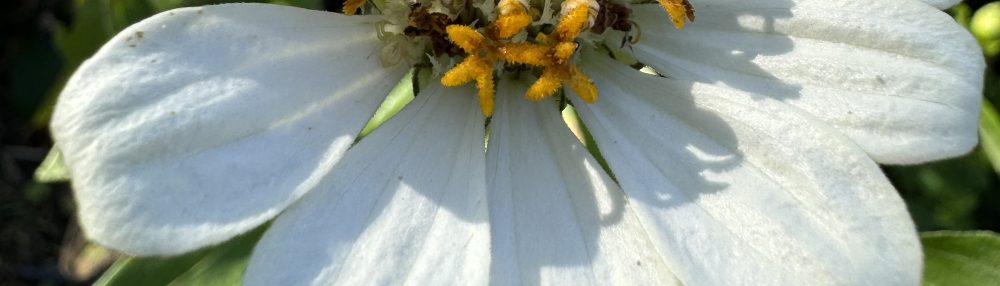
Photo and poem copyright 2023 Michelle Garren-Flye

Challenge Accepted: Learning something new

I’ve been a bit directionless recently. No idea what to do with my creative energy, so I’ve been shoving it down and watching Netflix instead (I’m rewatching Longmire, and it’s better than I remember from the first time around). (Side note: I need a Lou Diamond Phillips in my life.)

Back to learning something new. I decided I needed a direction, so I posted on social media and Twitter (Twitter is not social media, imo), asking for suggestions for my next poetry challenge. I didn’t promise to write, illustrate and publish another poetry book in less than a month, but I did indicate I might try.

Well, the challenge I got and accepted after some thought was a bit more complex than I’d anticipated. I don’t think I’ll manage another book in 30 days. It’s a whole new form to me and I’m loving it, hating it, cursing it—and learning it.

A villanelle is a sort of song poem with a rigid rhyme scheme that utilizes repeating lines, unlike most poetry. The best known one is Dylan Thomas’s “Do Not Go Gently Into That Good Night.” I have always loved that poem. I love the rhythm of it. I love the passion in it. I love the way you can almost unconsciously sing it without even meaning to.

The one thing I never loved because I never even noticed it was the rhyme.

How is that possible?? In multiple places “night” literally rhymes with “night”, “light” with “light”. How the heck did Thomas make his rhyme so invisible? It’s awesome that he did, because a poem with too heavy a rhyme will be singsongy and irritating. It may sound contrived. How did Thomas manage a poem with such a rigid rhyme scheme and make it sound natural?

The answer, of course, is that so much of the rest of the poem is more important than the rhyme. The passion, the theme, the message, the rhythm. All the things I’ve noticed that I love.

So that’s my new challenge. Write villanelles that don’t sound like they have a rhyme scheme. Or at least write villanelles where the rigid rhyme scheme doesn’t interfere with the message and passion of the poem.

Random picture of a perfect mushroom. Photo by Michelle Garren-Flye