I try never to let the winter solstice pass unnoticed. Of course I was asleep at 5:30 a.m. or whatever ungodly hour the solstice actually happened, but today is one of my favorite days.
The shortest day of the year.
I’ve watched the days get shorter since the summer solstice (you really can notice it after a week or two). Once daylight savings runs out, it’s really noticeable. Suddenly I have to hurry to walk my dog before it gets dark.
And then you get to today. The shortest day of the year in the Northern Hemisphere at least. And that means tomorrow it will be light longer. Today is not a day of darkness. It is a day of promise.
Tomorrow will be brighter.
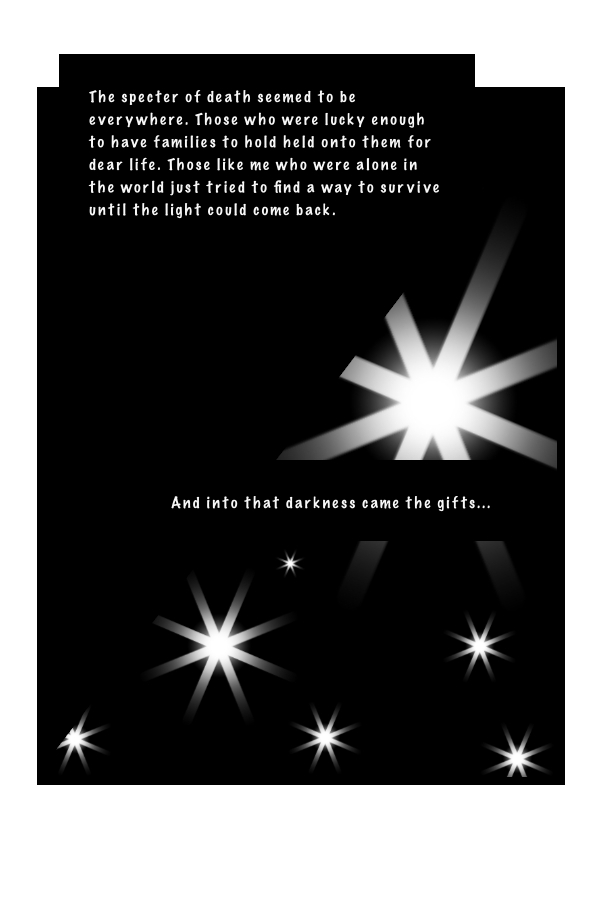
With that in mind, I thought I would share the first bit of something from my next comic, SeaGlass. Because that’s my promise. I’ll finish another comic next year.
From SeaGlass, my next comic. Art and words by Michelle Garren Flye
So goes one of my favorite songs by one of my favorite musicians. I’ve loved this song since I first heard it…well, last week. It took me a whole week to realize how appropriate this song actually was.
You see, I think those words are very true for most humans. We’re not called a “race” for nothing. All my life, I’ve been racing for one thing or another. To get an education, to get a good job, to have a family, to reach a point in my life where I’m totally fulfilled. Waiting to arrive. I’ve been lucky enough to achieve many of my goals. Some have escaped me. One in particular—to create a story that will capture the imagination of more than me—still dances just out of my reach.
But I’ve reached a point in my life where I wonder if maybe that might not be best.
Alan Shepard, the first man in space, emerged from his capsule and said, “Man, what a ride.” He’d achieved his dream. He’d been to space. Guess what he did then? He started trying to get back to space. In 1971, he commanded Apollo 14 on its mission to the moon, where he became one of the few who have walked on that gloriously inhospitable surface.
Man, what a ride.
I will never stop trying to string together words and now pictures to make that story that will suddenly become the story everyone wants to know. It’s my journey. I may never reach the end of it, but I have to believe there’s a reason I’m on it. Maybe when I reach my end, I’ll know for sure what that reason was. In the meantime, I’m just going to enjoy the ride.
I’m not sure where this came from except my frustration and angst boiled over a bit this morning. It’s sort of an apology to my kids. Give it some thought. Do you owe the next generation an apology?
Sometimes I’m attracted to a particular thing or sound or food/drink for no particular reason that I can name. My craving may attach itself to something I’ve known about and/or liked/loved for years. But all of a sudden, that’s all I want in my life.
What is this? It’s like a pregnancy craving. With my first son, I wanted milk all the time. Great, right? With my second, I wanted sweet tea, which sucked because I was living in Maryland at the time, and the only place to get good sweet tea was Bojangles. Thank God for Bojangles! My daughter was a different matter. I craved protein—in the form of hamburgers and steaks.
While I was pregnant, I figured cravings were trying to tell me something. I figure the same thing about these life cravings. Right now, all I want to listen to is Lifehouse and all I really want to read is manga/comics. I prefer drawing to writing, unless it’s poetry. What is my body trying to tell me?
Maybe it’s my spirit. Maybe it’s a type of spiritual pregnancy craving. I’ve completed my comic book (I’m moving away from calling it a graphic novel on my son’s suggestion), so it’s not that, but I can’t escape the feeling that my cravings relate to what’s happening in my creative life. In some way I can’t honestly name.
We’re in the middle of autumn here in Eastern North Carolina. What does that mean? Beautiful trees and fire in the fireplace at night?
Hell no.
Most of our trees are evergreens, I think. We have a very few deciduous trees mixed in. But there are a few. And you catch glimpses of other color here and there. Temps are still averaging around 80 degrees although we’re no longer sitting on the Devil’s front porch (upper 90s). Still, there is beauty, and after living here for sixteen years, I’ve figured out how to find it.
Atypical Autumn
By Michelle Garren Flye
A fall like no other
With colors streaming
Like wild things at a party
Look there and there
Crimson poison ivy scales
The evergreen’s bark
And the pink magnolia seed
Gathers a fuzzy coat
Before it erupts to scatter
Scarlet hearts to unsuspecting birds
Spring and summer linger
In lemonade lantana
And late roses
If tradition is what you seek
Look to the dogwood
As its leaves brighten and fade
Chrysanthemums will blaze
And you might find a maple or two
But don’t expect too much
Atypical autumns don’t behave
The way you want them to
You have to adjust yourself
To see the beauty that’s there
And not wish for what
This season cannot be.
And with all that said, I should also add that I have recently completed edits on my graphic novel. Yeah, I know, that was fast! It feels weird that it went so fast. I think that’s the way things are when you’re driven to finish. Being completely self-published, I don’t have actual “deadlines”. Once I wrote this story, though, I knew I wanted to share it and my vision of it. Being able to do that in a visual way was very exciting to me. I’ve never been able to do that before except with my poetography. 😉 So, I’ll go ahead and announce that the kindle version of my graphic novel Hourglass is for pre-sale now on Amazon. The print version may take a little longer, and I definitely think it will be worth waiting for. I mean, who wants to read a comic book on their phone, right?
“We are witnessing the consequences of three years without mature leadership.” —Former Secretary of Defense James Mattis, June 2020
I actually don’t think that’s all we’re witnessing. I think our problems run much deeper. Four hundred years deep, dating back to the day the first slave stepped off the ship onto the soil that would one day be the soil of the United States.
Oh where were our visionaries then?
I suppose we could look to our founding fathers. Well, not all of them. But Benjamin Franklin allowed himself to be educated on the slave situation, though he remained pessimistic about integrating Black people into society. However, a thoughtful, intelligent man could not help but be troubled by what he himself saw as “an atrocious debasement of human nature”.
Yet he owned two slaves himself. And Benjamin Franklin was the best white man we had to offer at the time.
Jump ahead a few centuries. On June 16, 2015, Donald J. Trump announced he was running for president. Less than a year later, it was obvious he had the support to win. To the befuddlement and consternation of thoughtful, intelligent people everywhere, Donald J. Trump went on to become president of what was once the greatest nation in the world.
Life went on, but from that moment, the rights of the marginalized were under attack and in danger. As Mattis says, we haven’t had mature leadership. We have had evil leadership. Ignorant leadership. Leadership with the rights and privileges of the rich and powerful and white (and mainly male) prioritized. And our institutions have suffered because so much of them is controlled by that very demographic. It’s hard to stand up for what’s right when your stock portfolio is soaring. It’s hard to be concerned about “the others” when your race/religion/party is on top.
“The founding fathers, in their genius, created a system of three co-equal branches of government and a built-in system of checks and balances. I feel as though that is under assault and is eroding.” —Former Director of National Intelligence James Clapper, May 2017
Turns out Clapper was right. Our institutions have crumbled. Our checks and balances are nearly gone. And now we have a choice to make. The economy is on the verge of recovering after the blow it was dealt by Trump’s mismanagement of the coronavirus crisis. We haven’t seen the last of COVID-19, but people are learning how to live with the danger. That’s not even the wrong thing to do. We had to adapt. We are strong that way. Where we are weak is remembering the bad times.
Black Lives Matter has a chance for the first time in our history to make a difference. As a Southern White Woman—which I put in capitals because I worry constantly that it defines me to others, but, worse, to myself—I know this is important. It is important to every marginalized human being in our country including women, but it is most important to the Black community, which may finally throw off four hundred years of oppression.
Can we as a nation find the strength to resist a government which would oppress all of us—all but the powerful, white, and rich? Can the powerful, white, and rich find it in themselves to resist the call of more power and more money? Some have. James Mattis was one of them. There have been others.
“We have a moral obligation to continue in our just cause, and we would bring more than shame on ourselves if we don’t. We will not thrive in a world where our leadership and ideals are absent.” —Senator John McCain, October 2017
“Without fear of the consequences and without consideration of the rules of what is politically safe or palatable, we must stop pretending that the degradation of our politics and the conduct of some in our executive branch are normal. They are not normal. Reckless, outrageous and undignified behavior has become excused and countenanced as telling it like it is when it is actually just reckless, outrageous and undignified.” Senator Jeff Flake, October 2017
Can others follow? Can we all come to realize what is wrong is wrong even when it is not in our own interests? I don’t know. In November 2020 I hope I will find out. I pray what has been normalized—whether that has happened over four years or four centuries—will be rejected. Only then will the symbols of freedom we treasure mean anything at all.
Oprah Winfrey is quoted as saying, “Reading is a way for me to expand my mind, open my eyes and fill up my heart.” That is indeed what reading is for many today. But it’s also a privilege and a right that human beings of all races had to fight for.
Before the invention of the printing press, only the upper classes had books to read. They were just too expensive for the common folk. Too busy surviving plague and poverty, many of these people never learned to read. Bibles, especially, were kept to the clergy and the church, mainly because they were the only ones who could read it in its original Latin. God forbid that the lower classes read it for themselves and start thinking and interpreting religion for themselves.
But then came the English translation of the Bible—which was banned for that very reason. It was smuggled into English hands by determined bibliophiles, but William Tyndale, the translator who lived in exile in Europe in order to complete his life’s work, was executed.
Of course slaves were not allowed to learn to read. Not only were there no schools for them, it was against the law to teach them in most slave states. But learning finds a way. Some slave owners allowed their slaves to learn to read as part of Christian education, and some educators found interesting ways around the laws, including a floating school on the Mississippi River.
My point here is that all cultures and races have fought at some point for the right to read and write, and in an era such as the one Americans are going through right now, we need to preserve every last bit of that right. Our president threatens social media and the press, bookstores in Minnesota are battered by protestors and looters, and all of this is happening against a backdrop where independent bookstores and small presses are struggling for survival anyway.
So my plea is this: Don’t be part of the forces that would oppress you and take the light of knowledge away. Don’t burn the bookstore your ancestors fought for.
Photo by Michelle Garren Flye
Today’s anti-information, non-factual age is a dangerous one for local bookstores, the media and science. In the end, it is up to us to make certain our heritage and ways of life are preserved. Protect what generations of every culture have fought for. Keep our bookstores open.





 BREATHE: Michelle Garren-Flye