
Gathering raw material.

I’m on vacation, which means I’m not writing, but I’m not just gathering rosebuds. As a writer of romantic fiction set (mostly) in the South, I’m always doing research. I’m gathering material. Raw material. Very raw, some of it. For instance, yesterday, I saw alligators. Enormous alligators. Some of them with heads as large as my five-year-old daughter and tails as long as me. Here’s a sample:
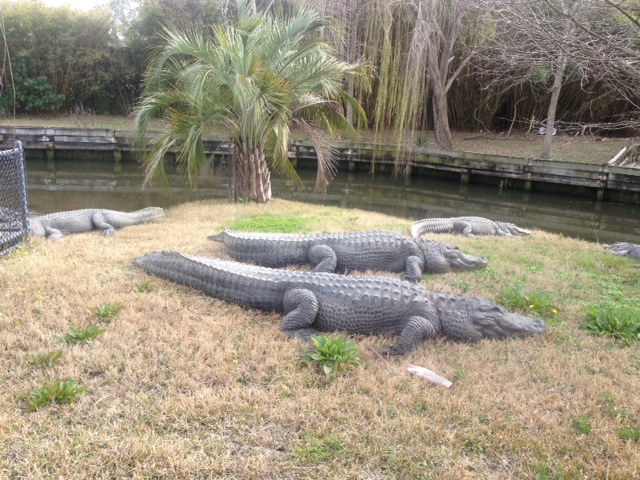
Very large alligators.

Very large alligators.

I was in awe. Very impressive. I tend to put things that impress me into my stories, so you probably shouldn’t be surprised if gators figure into a future storyline pretty prominently. I also saw some other rather impressive reptiles in the scaly flesh. I’ve admired the king cobra for a long time. I used to draw pictures of them on my notebooks at school. I thought they were badass. Seeing one in person did nothing to dispell that image for me, either. To quote me: “Oh my God, that’s all one snake.”

Yes. It's all one snake.

King Cobra

I can’t quite figure out how to fit a cobra into one of my southern romances, but an equally impressive and much more likely alternative might be the cottonmouth or water moccasin. As luck would have it, a few tanks down from the cobra, I encountered one of these, thankfully with a wall of glass between us.

Water Moccasin

Water Moccasin

I couldn’t take my eyes off this one, but in spite of the glass between us, I didn’t dare get too close, either. I’ve grown up around snakes and I’ve always been warned to stay away from all of them, but the cottonmouth is the one that I’ve heard the worst stories about. The rattlesnake warns you, the copperhead hides from you, but the cottonmouth will come after you if you piss him off.

So how can I fit all these cold-blooded reptiles into my love stories? I can’t swear I can. I already had a heroine do battle with a copperhead in Where the Heart Lies. (I did enjoy writing that scene, which was inspired by finding a copperhead in my own backyard. I didn’t kill it, by the way. My husband did.) I do know a warm fire feels much warmer after you’ve been outside on a cold day, though, and it might be interesting to find out how hot and bright the flame of romance might burn against a colder backdrop than what I usually use.

Might. Remember: raw material.

“What’s the best piece of writing advice you’ve ever been given?”

In the course of Googling something else the other night, I ran across an article on a blog that intrigued me. The blogger devoted his entire time to tearing down a very successful author, whose name I shall not mention. In a nutshell, the blogger said she loved this particular author UNTIL she started following him on social media where said author made a number of missteps. Her main complaint, however, was that he never offered anything to the aspiring writers who clustered about him waiting for a morsel of genius to fall on them.

Instead, the author in question would fill his Twitter feed with his daily word counts, bits from his new books, or his favorite quotes from his old books. Why doesn’t the author just be himself? the blogger asked.

(Ahem. Possibly because he might not be his actual self. Lord knows, if I ever get to the point he’s at, I’m going to hire someone to handle social media for me. It’s part of the job of being a writer, but if you can afford to pay someone else to do it for you so you can keep doing what you really enjoy doing—writing—well, who can blame you…much?)

But I digress. This article got me thinking. Have I ever gotten any actually useful advice from a successful published author? I’ve seen several speak. Some tell stories about how they became successful. Sometimes you can glean some bit of something useful out of that, but for the most part, you’re left wondering, Why couldn’t that happen to me? Every now and then, though, somebody says something that sticks with you, that really helps.

Unfortunately, I honestly can’t remember who said the most useful writing tip I ever got from a published writer. I think it was a man, and I believe it was while I was in college. Other than that, I’m at a loss. At any rate, what he said was, “Tell you readers your secrets.”

That startled me. My secrets. He was talking about writing fiction. Novels. Not true stuff. Why would I tell my secrets? Real stuff. But I’ve found over the years that he was right. If you mix a little bit of reality into your fiction, it makes it live and breathe in a way that purely made up stuff could never do. And the great thing is, you don’t have to tell your reader what bits are true. You just write from the heart, mix in things that are true with things that you wish could be true or you fear ever coming true and what results is so much more than fiction.

Here’s a bit of writing advice from me, a published, if not yet successful, author. Don’t expect too much from your heroes. No matter how successful they are, they’re caught up in a balancing act, just like the rest of us. They may not have to make ends meet financially (well, the top 1% don’t, anyway), but they are trying to balance marketing and social media and family with what they really probably still want to do—writing. So don’t expect too much, but listen when you’re lucky enough to hear one speak. They might just give you that tidbit you’ve been waiting for.

What’s in a word? $#*% by any other name would smell as $#%%^, wouldn’t it?

This is how it happened.

I’m driving down the road the other night and a possum walks out in front of me. More than just about any other wildlife, possums freak me out. There’s something downright evil in the way they turn their long rat-like snouts to look at an oncoming car. Hit me. I dare you. Of course, most of them lose that particular battle, but they still startle me with their glares.

“Oh, (expletive deleted).” I slam on the brakes and swerve to avoid the creature.

My daughter, who has been playing quietly on her iPod in the backseat, says calmly in her little innocent voice, “What’s wrong, Mommy?”

“I almost hit a possum.” I wonder why I didn’t just go ahead and hit the thing. Why go out of my way to avoid something that I don’t like? Maybe it’s a deep-rooted fear that this one won’t die. It’ll grab hold of the undercarriage of my car and wait until I park and, unsuspecting, climb out, exposing my ankle to its sharp teeth and claws…

“What?” My daughter can’t place what kind of critter I’m talking about.

“You know, those things we see squished on the side of the road all the time.” (I’m probably not going to get mother-of-the-year for that definition, but it had been a long day, and last I heard I’m not in the running away.)

“Eww.” She exclaims as only a dramatic five-year-old can. But she knows what I’m talking about now.

I laugh and continue driving. It’s only later that I realize I used a curse word in front of her and she didn’t react to it. She’s heard it before…from me. Have I desensitized her already to the power of profanity? The thought is sobering.

As a writer, I’m interested in language and how certain words have more power than others. I’ve read countless articles about words and how their sounds affect people in different ways. (Here’s a really interesting article about the subject: Which Words Do You Love and Which Do You Hate?) Profanity is fascinating because so many people have such adverse reactions to the ugly words. Including me. I flinch when I hear certain words. They’re unpleasant. They have power over me.

When I was in high school, I knew a boy who always said “sugar” instead of “(expletive deleted)”. I thought it was cute. I thought he was cute. I knew what he meant, but by replacing the expletive with a much sweeter (pun intended) word, he accomplished something many of us have yet to figure out how to do. He used the power of language in a positive way.

Which leads me to my vow. I’m going to be a less profane person. Don’t get me wrong, I’m not horrible, but a “bad word” pops out every now and then. I’m not doing this because I think it’s wrong to curse, but because I want my kids to understand that words do have power over people. You can use them in a positive way (think speeches by great men like Martin Luther King Jr. and JFK) and influence people for good. But if you go throwing profanity and other negative words around, eventually the people around you become desensitized to your voice. What you say fades away and becomes less important, and when you do have something positive to say, you’ll be lucky if anybody hears you.

The End of the World? Don’t Hide. Live Better.

Today I’m not going to write about the news stories that are terrifying and saddening the entire world. I’m not going to talk about the innocent victims or possible solutions or call for gun control or better care for the mentally ill, although I think those things are well worth discussing. I’m writing because it seems the world has gone mad, and I feel a need to ask you all not to let the end of the world become a self-fulfilling prophecy.

This is what has haunted me ever since I heard about the end of the Mayan calendar and how many millions of people actually harbor some belief that Friday will be the end of the world: What if it’s not? What if God has no intention of ending the world on Friday, but as the “end” that we have prophesied for ourselves approaches, people go mad and society destroys itself? What if we ruin our world and kill each other and those who survive have a world no longer worth living in?

The holiday season always brings out the madness in people. It enhances the divide between those who have so much and those who have nothing. I believe this holiday will be even worse than usual and that’s why I’m writing. This holiday, I’d like to encourage everyone to think a little bit about your neighbors. Do they have enough to make their Christmas merry? Do they have someone in their lives to love or are they alone? Reach out and shake someone’s hand or leave a small gift for someone you think might not get something this season. If you’re not comfortable with that personal approach, give something to your local Food Bank or other charity.

I plan to do some soul-searching today to think about what I can do this season. I want to go a little beyond what I usually do. I want to try to make a real difference this year. I don’t know if the Mayan calendar means anything or not. I don’t honestly think we can predict the end of the world. What I do know is that nobody’s tomorrow is ever guaranteed, and if we don’t try to make a difference today, we may never get a chance. After all, where would you rather be if God comes down to judge us? Helping someone in need or hiding in a Doomsday bunker?

Ten reasons to vote today–out of the horse’s mouth, so to speak

1. If you fear making anyone mad, then you ultimately probe for the lowest common denominator of human achievement. — Jimmy Carter

2. I hate to see complacency prevail in our lives when it’s so directly contrary to the teachings of Christ. — Jimmy Carter

3. We become not a melting pot but a beautiful mosaic. Different people, different beliefs, different yearnings, different hopes, different dreams. — Jimmy Carter

4. Let us not seek the Republican answer or the Democratic answer, but the right answer. Let us not seek to fix the blame for the past. Let us accept our own responsibility for the future. — John F. Kennedy

5. Change is the law of life and those who look only to the past or present are certain to miss the future. — John F. Kennedy

6. The time is near at hand which must determine whether Americans are to be free men or slaves. — George Washington

7. Nobody will ever deprive the American people of the right to vote except the American people themselves, and the only way they can do this is by not voting. — Franklin D. Roosevelt

8. Americans…still believe in an America where anything is possible. They just don’t think their leaders do. — Barack Obama

9. Leadership is about taking responsibility, not making excuses. — Mitt Romney

And finally:

10. Do what you can, with what you have, where you are. — Theodore Roosevelt

That last one really says it all, doesn’t it? Source for all quotes is BrainyQuote.com.

Playing with Emotions: What do you want to feel when you read?

I’ve been thinking about this for a while. Since I gave up writing horror, actually. Surprisingly, however, the story that got me thinking about it again was a horror story. I finally got around to reading my friend John Peters’s story “Summer’s End” the other day. It’s not that I didn’t want to read it. In fact, I downloaded it weeks ago. It’s quite simply that I don’t have time to read anymore. Between my kids and my volunteer work and my own writing and just day-to-day life, reading has come in last on my to-do list for quite a while.

(BTW, my trip to Las Vegas the other day may have changed that. For four glorious days, I had, for a change, enough time. I wrote, I read, I slept, I had leisurely lunches with my husband and I shopped (a little). What luxury!)

It was on the way to Las Vegas, in fact, that I picked up “Summer’s End”. I expected it to be good. JP2 (his nickname from our old Horror Library group) is an excellent writer. I knew I’d be drawn in and find it difficult to put down. What I didn’t expect was how the story played on my emotions. Disgust, horror, and, finally, righteous indignation. I felt them all while reading this tale. And it got me thinking.

We writers play with emotions in our stories, but what we’re really playing with are our reader’s emotions. If we get good, we can make you cry, laugh, feel sick to your stomach (JP managed that one pretty well!) or get angry. But why do readers seek this stimulus? And what are they looking for in it? I can’t honestly answer this question although as a reader, I know I’ve sought all of the above, and as a writer, I’ve explored all of it (except maybe making you sick to your stomach—well, maybe…). In fact, the reason I stopped writing horror was because I wanted to make my readers feel better about the world around them.

What I realized after reading “Summer’s End” was that maybe that’s the point of horror, too. Maybe after you read a good horror story that’s really made you sick to your stomach, you stop and look around you and realize this world is so much better than that one…feels pretty good, huh?

I encourage everyone to read a good horror story before Halloween. Maybe you should start with JP2’s “Summer’s End”…

Is it a sign of immaturity that I like Nickelodeon? REMINDER: Enter to win!

Seriously. I’ve always loved Disney, but recently I’ve found myself watching Nickelodeon shows with my kids, and now they’re being DVR’d because I don’t want to miss them! On my DVR: iCarly, Victorious and Drake & Josh. MOST of the time, I watch them with my kids.

Nickelodeon—like Disney—has a habit of creating what I consider “plastic” stars. Many of the young stars on their shows are multi-talented. They act, they sing, they dance. But often the real talent there is overshadowed by Nickelodeon’s managing and molding. It’s like finding a pretty rock and instead of polishing it up a bit and enjoying it, you have to cut facets where facets weren’t meant to be and don’t really improve anything. And yet, some of these kids manage to shine, even through the plastic coating.

Miranda Cosgrove of iCarly was the first Nickelodeon star to catch my attention. It was back when my younger son teased my older son about watching “teenage girl shows”. Well, I was once a teenage girl and I know what kind of trouble they can be, so I figured I better watch some of these shows with him. To my surprise, I found I enjoyed it, mostly because I could see some real talent in the cast of iCarly. I laughed at their antics and even teared up once or twice (yeah, I did).

It’s a slippery slope from one Nickelodeon show to many. My son and I discovered Victorious together, and I love that show. Set in a high school for the arts, it’s peopled by some pretty spectacularly talented kids, and the cast is led by Victoria Justice, whose music, I’m not even ashamed to say, is in my iTunes library.

So am I reliving my childhood by watching this stuff? Does my brain atrophy every time I sit down in front of it? Is it just good quality time with the kids? Who knows? I don’t even care. It is good quality time with my kids that I enjoy. And if it’s not exactly stretching my brain, well, maybe my brain needs a rest every now and then.

Oh yeah, before I go, remember to leave me a comment to enter to win a print copy of Foreign Affairs, the anthology from Turquoise Morning Press with my story “Agapi Mou”!

E-Reading: 10 Things You Don’t Want to “Hold in Your Hand”

“I just can’t do that e-reading thing. I prefer to hold a book in my hand.”

Before I started being published in e-book format, I was just as resistant to e-readers. I love books. Every room in my house has books in it. All three of my children have books on shelves, in drawers, under beds. Hell, I used to be a librarian. I’m a reader. You know what used to drive me nuts?

Leaving the book I was reading at home.

You know that feeling. You find yourself in the doctor’s office waiting much longer than you’d anticipated. The magazines are either old or uninteresting. You find yourself longing for the book you were heart-deep in, the one that you just reached the climactic point of before time to leave the house. That book that’s sitting on the kitchen counter.

Ah, but if you were reading that book on your NOOK, even if your NOOK is sitting on the kitchen counter, you’ve probably got your smartphone with the NOOK app on it…and wah-la! Put your phone in airplane mode, pull up your book and start reading. Same thing for the Kindle. You NEVER don’t have your book.

So, although books are great and very pleasant to the touch, I thought I’d make a list of ten things that would be even worse to hold in your hand than an e-reader.

10. Anything your kid spits out of his mouth.
9. A slug.
8. A live cockroach.
7. A squished cockroach.
6. A hot coal.
5. That gooey slime stuff Nickelodeon uses all the time.
4. Chewed bubblegum.
3. Chewed bubblegum from under the seat of a chair in a doctor’s office.
2. Used cat litter.
1. An actual physical copy of 50 Shades of Grey.

E-reader doesn’t sound so bad now, does it?

Learning to Write: When Does It Actually Happen?

A federal report released yesterday says students in the United States lack writing proficiency. The study, conducted last year, tested the writing skills of samples of eighth and twelfth grade students. They were allowed to use a word processing program, complete with spell check (thank heavens), dictionary and thesaurus. The result? Twenty percent of eighth graders and twenty-one percent of twelfth graders scored “below basic”. Only twenty-seven percent of students in each grade level were considered proficient or advanced.

I wasn’t even surprised. I know what a chore it is to get my third-grader, who is very bright, to write a sentence with more than four words in it. And my seventh-grader, also a very good student, considers a page and a couple of lines to be a two-page essay. And then I can also remember my own school days—back when you had to hand-write reports. Remember then? Remember when your teacher told you write a five hundred word essay on the American Revolution, and you painstakingly wrote exactly five hundred words, pausing to count every few minutes to see if you’d written enough? Remember saying “very, very” so you could get two words for the price of one? (“The American Revolution happened in 1976 and it was very, very bad. Lots of people died.”) Remember all the adjectives you stuck in to help you obtain the required word count? (“The British wore really bright red coats with really bright white x’s across their chests, so Americans called them Red Coats.”)

(Ha ha. I laugh. I’ve been writing five minutes and have already achieved 225 words. And according to my spell check, they’re all spelled correctly, too.)

Even in college a thousand words seemed unachievable. I remember wondering how on earth doctoral students ever came up with 20,000 plus words to write about a single subject. I also remember the D I received on my first English literature paper.

Ouch.

So, really, I wouldn’t have scored too well on the national writing exam, either, in either eighth or twelfth grades. I learned to write in college. I can’t remember the name of the professor who taught me what it means to write a real research paper, but I’m very grateful he took the time to do it. I hope he knows I continue to put one word in front of another in my march along the literacy path.

What does this mean for the students of today? Is it hopeless? Is this another sign that our education system is broken? Nah. Teachers will continue to teach and students will continue to (albeit reluctantly) learn. As their brains mature, the smarter ones will grasp the concept of writing persuasive essays, just as they always have. If they take their writing to the next level, they’ll figure out how to leave out the adjectives. But most of this will come after high school, unless they’re lucky enough to go to a school that helps them obtain life experience before leaving the nest.

And hey, maybe some of them will even become romance writers. That would be very, very cool, don’t you think?

(For the record, this essay was more than five hundred words. And I wrote it in less than half an hour.)

(And, ahem, I found no less than three typos in the course of editing it!)

Success in Writing: What it Takes

I recently read an article about how much you should write every day in order to be a successful writer. I always read these articles and smile a little because I’ve read so many of them, and I know every writer is different. You may read an article that says to write a certain number of words, no matter how long it takes. Another will state positively that you must write for a certain number of hours every day. No matter what, sit down at your desk for that amount of time.

The most popular question people ask me when they find out that I write is “Where do you find the time?” I actually like this question because it shows some understanding of what a mother’s writing life is. It’s getting up at the break of dawn and getting the kids off to school and writing furiously for an hour before you have to run errands or clean the house or exercise or whatever. Then it’s rushing back to get a few more minutes in before the first pickup of the day.

After that, my writing time comes in what I call my “stolen moments”. All of a sudden you realize the kids are busy with homework, the house is clean(ish) and you’ve got fifteen or twenty or thirty minutes before you have to fix dinner. Or the kids are all in bed and your husband is busy and you’ve got an hour before you need to get to bed.

That’s what it takes to write a novel when you’re a mom. The sound of the school bell affects me like Pavlov’s dogs. I begin to salivate, looking forward to my writing time, and I imagine it’s the same for moms who write everywhere.

But what does it take to succeed in writing? I think Stephen King has it right. He says you have to write a lot. Like anything, writing takes practice and every word you write gets you closer to that nirvana of perfection. Whether or not I’ll ever achieve it, I don’t know. I’m working toward it every day, on this blog, on the guest posts I do for my book tour, on my work-in-progress. Everything I write is a step closer.

In case you missed it, I took one of those steps yesterday on Welcome to My World of Dreams. You can find my guest post here: A Writer’s View: Michelle Garren Flye. Don’t forget to stop by every Monday through the end of November for a link to my next blog tour stop!